Local SEO is the practice of increasing a business’s visibility for searches with location intent, including Google Maps, the local pack, and localized organic results. The goal is not merely to rank. It is to help people in your service area find your profile, call, request directions, visit your website, and become customers.
This guide covers local SEO from strategy through execution: how local results work, Google Business Profile, keyword research, location pages, citations, reviews, measurement, costs, and choosing a local SEO company. The examples apply to physical locations, service-area businesses, multi-location companies, and B2B teams that serve defined regions.
Editorial note: this guide was written by George Vie, Head of Digital Marketing at LINC, based on the SEO audit, content mapping, tracking, and lead-evaluation workflows used in digital marketing work. Business examples and target numbers are illustrative. Google Business Profile policies were checked against Google’s official documentation. Updated July 28, 2026.
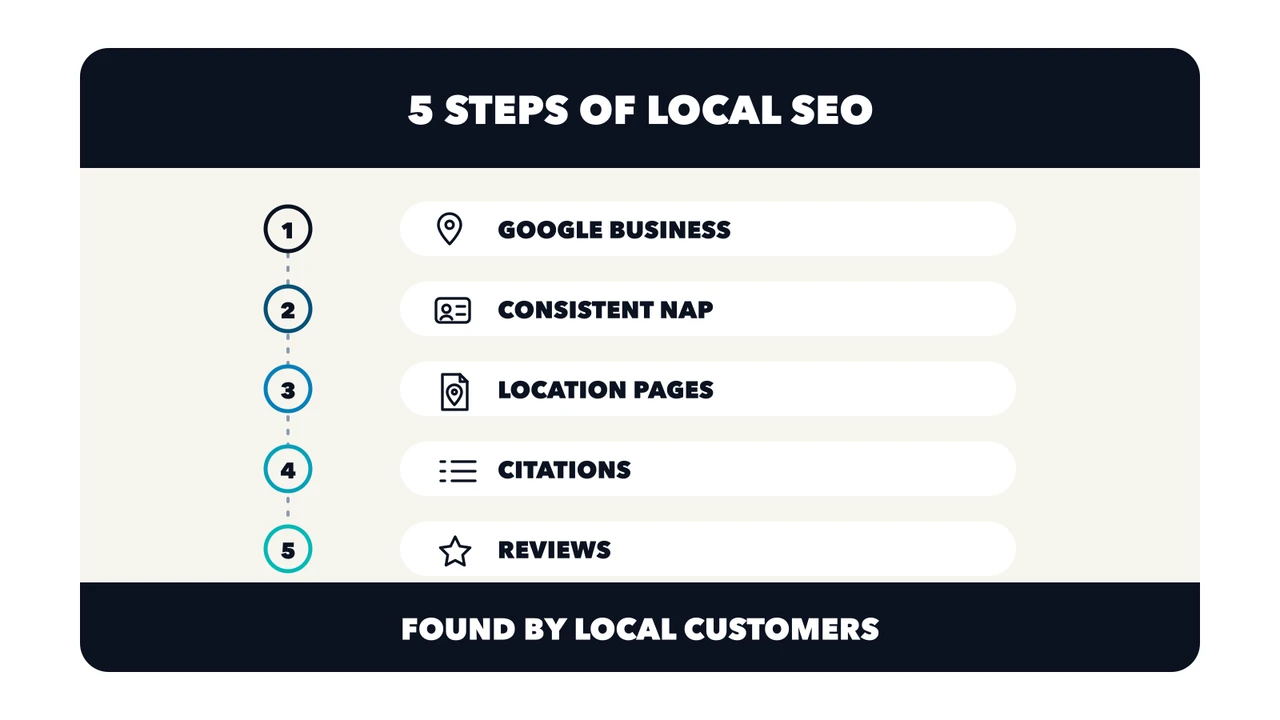
Why is local SEO important?
Local searches commonly happen after people understand their need and begin choosing a provider. They are not only looking for information. They want to know whether a business is available, nearby, trustworthy, and easy to contact. Local SEO can therefore influence several stages at once:
- Discovery: the business is found for a relevant service and area.
- Consideration: prospects compare ratings, reviews, photos, services, and proof on the website.
- Action: searchers call, request directions, open the website, send a WhatsApp message, or book.
- Conversion: the team turns those actions into leads, visits, and sales.
Local SEO also reduces dependence on one channel. A business profile can generate calls and directions, while organic pages explain the service and capture demand that requires more research.
It is not a priority for every company. A digital product with no face-to-face interaction, a national marketplace with no customer location, or a company that does not limit its service area will usually benefit more from general organic SEO first. Google requires a business creating a Business Profile to make in-person contact with customers, subject to exceptions in its Business Profile eligibility guidelines.
What is local SEO?
Local SEO is the part of search engine optimization that helps a business appear when a search is influenced by location. Examples include:
- “dentist near me”
- “air conditioner service South Jakarta”
- “office network vendor Surabaya”
- “Japanese restaurant open now”
- “local SEO company Indonesia”
Google can infer local intent from words such as “near me,” a city name, or the device’s location context. Searchers do not always have to type a city for local results to appear.
Local SEO operates across two different surfaces:
| Surface | What appears | Main signals | User goal |
|---|---|---|---|
| Local pack and Google Maps | Map, business profiles, reviews, hours, calls, directions | Profile relevance, distance, prominence, data completeness | Choose a business and act quickly |
| Localized organic results | Websites, service pages, location pages, articles | Page relevance, content quality, technical SEO, backlinks | Compare and understand services |
A business needs both. A Google Business Profile without a strong website limits information and measurement; a website without an accurate profile misses opportunities to appear on Maps.
Who needs local SEO?
Local SEO matters when location affects the buying decision or the business’s ability to serve the customer.
| Business model | Examples | Primary focus |
|---|---|---|
| Customer-visited location | Clinic, restaurant, shop, repair workshop | Maps, hours, directions, reviews, photos |
| Service-area business | AC technician, catering, network installer | Service area, category, calls, regional service pages |
| Multi-location company | Retail branches, clinics, franchises | Profile per location, data governance, unique location pages |
| Regional B2B business | IT vendor, contractor, distributor | Service + city keywords, capacity proof, coverage, leads |
A business that travels to customers can use Google Business Profile as a service-area business without exposing a home address or an office that does not receive visitors. The setup must follow Google’s business representation guidelines.
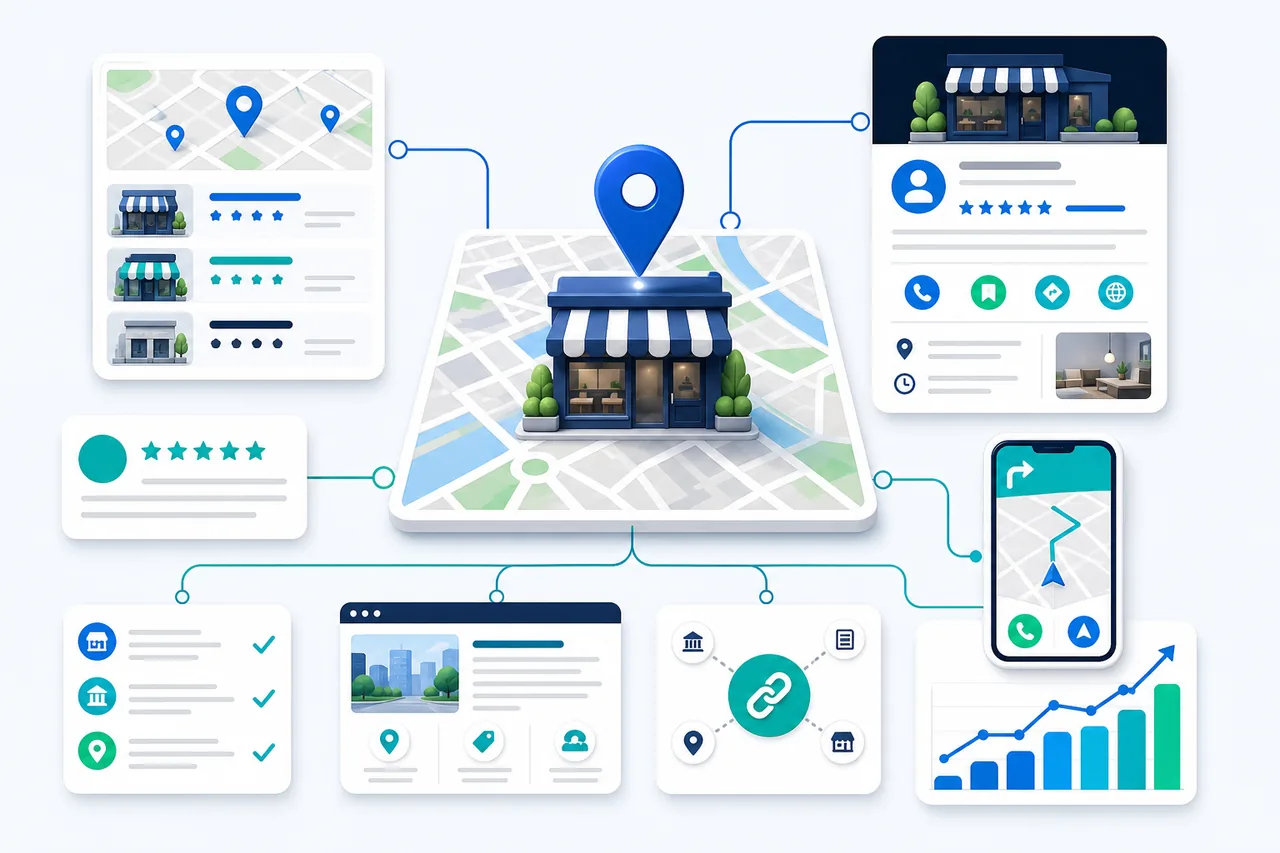
How does Google rank local results?
According to Google’s official documentation, local results are primarily based on three factors:
- Relevance. How closely the profile and website match the service being searched.
- Distance. How close the business is to the searcher or the location named in the query.
- Prominence. How well-known and trusted the business is based on reviews, links, articles, directories, and real-world reputation.
Distance cannot be manipulated. Healthy local SEO concentrates on the two factors a business can strengthen: relevance and prominence.
| Factor | What you can improve |
|---|---|
| Relevance | GBP categories, services, accurate descriptions, service pages, local keywords, content |
| Distance | Correct address or service area; never create a fake location |
| Prominence | Genuine reviews, citations, local backlinks, coverage, brand mentions, reputation |
There is no button, payment, or inside channel that buys a higher local position. Google explicitly states that a better local ranking cannot be requested or purchased.
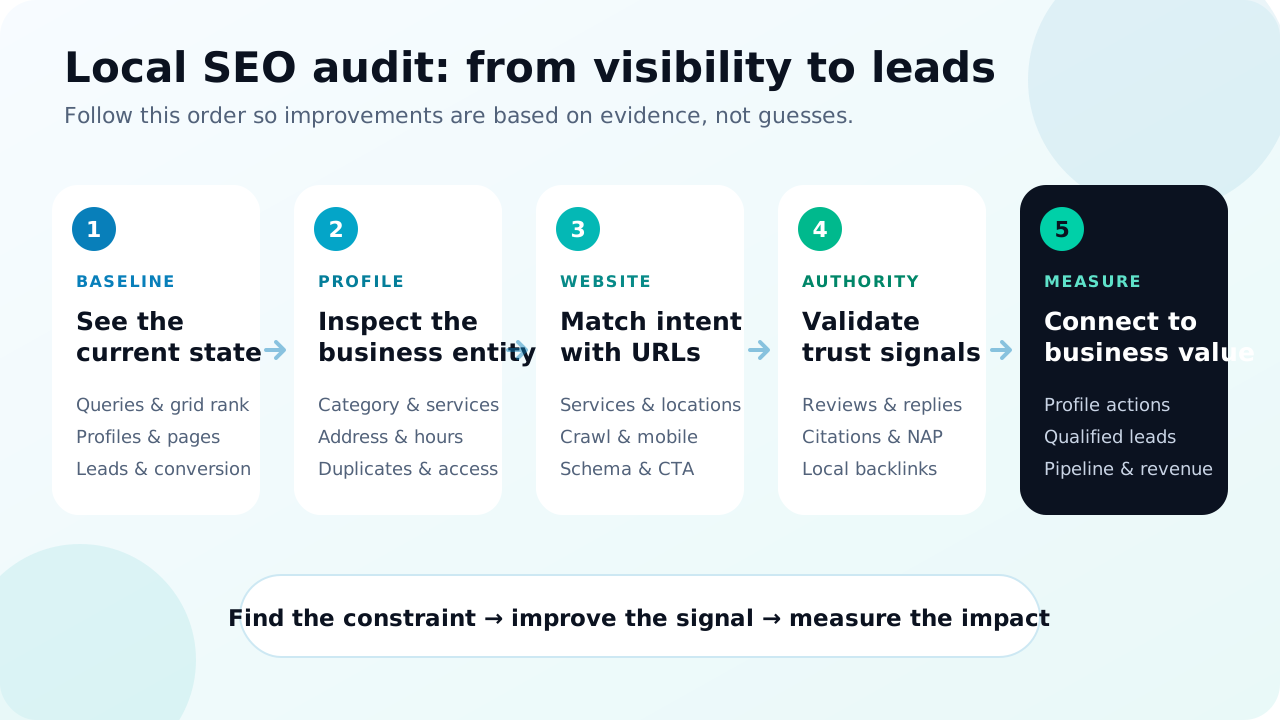
How to conduct a local SEO audit
An audit establishes a baseline before anyone changes the profile, pages, or citations. Without it, the team may see rankings move without knowing which work contributed or whether the change created leads.
1. Record current visibility
Collect queries from Google Business Profile and Google Search Console. Record map-pack positions at several points across the service area, not only at the office. Capture pages already earning impressions, profile actions, leads, and conversion rates.
2. Audit the profile and ownership
Check verification status, primary owner, managers, business name, categories, address or service area, phone, URL, hours, services, photos, and duplicate profiles. An agency should never be the only owner of the asset.
3. Audit the website
Confirm that every important service and location has the right URL. Test crawlability, indexability, canonical tags, mobile experience, internal links, NAP, schema, calls to action, and tracking. Compare pages earning impressions with those expected to produce leads.
4. Audit authority and reputation
Compare review volume, rating, recency, themes, and response practices with businesses that actually compete in the area. Check primary citations, inconsistent data, local backlinks, brand mentions, and partnerships that have not yet produced a link.
5. Prioritize by constraint
Use impact × confidence ÷ effort. An unverified profile, non-indexable service page, incorrect phone number, or broken tracking is usually more urgent than publishing another article.
How to conduct local SEO keyword research
Local keyword research starts with services, not a list of cities. Record what the business actually sells, how customers describe it, and where the team can genuinely provide it.
1. List services and problems
Separate keywords that represent different needs. “CCTV installation” and “CCTV repair” require different messages, proof, and calls to action. If the intent is different, consider separate pages.
2. Add local modifiers
Combine each service with:
- a city, district, or service area;
- “near me” and “nearby”;
- customer types such as B2B, office, home, or industrial;
- buying-stage words such as cost, service, vendor, audit, or consultation.
Examples include office network installation Jakarta, CCTV vendor Surabaya, and local SEO company Indonesia.
3. Inspect the search results
Search the keyword from the target location. A map pack and local businesses indicate local intent. Record which page types appear: homepages, service pages, location pages, directories, or educational articles.
4. Map keywords to URLs
Do not make one page for every minor variation. Group terms with the same service and intent into one URL. Create a new page only when the user need, service, or location requires a materially different answer.
| Cluster | Example keywords | Best page type |
|---|---|---|
| Education | local SEO, what is local SEO, local SEO guide | A pillar guide like this article |
| Service | local SEO services, local SEO company | A service page |
| Location | local SEO Jakarta, local SEO Surabaya | A genuinely unique location page |
| Implementation | Google Business Profile optimization, NAP audit | A focused article or service |
How to analyze local SEO competitors
A local competitor is not always the company your sales team considers a rival. For each keyword, an SEO competitor is a profile or domain that actually appears in the local pack or organic results.
- Choose a query and search points. Use one service, one area, and several points that represent where customers are located.
- Separate the local pack from organic. A profile that dominates Maps may not have the strongest organic website.
- Compare profiles. Record primary and additional categories, services, hours, attributes, photos, review patterns, and data completeness. Never copy a business name or category that does not accurately represent your company.
- Compare pages. Inspect the URL type, search intent, service coverage, local proof, FAQs, calls to action, schema, internal links, and backlinks.
- Look for patterns, not anomalies. If four of five results use a dedicated service page, that is more meaningful than one competitor with a keyword in its business name.
Use a simple matrix:
| Area | Question | Possible decision |
|---|---|---|
| Profile | Are our category and services less accurate? | Correct the profile to match the real business |
| Reputation | Are our reviews fewer, older, or unanswered? | Build a review and response workflow |
| Content | Do competitors answer needs we have missed? | Expand the page that already matches the intent |
| Location | Does an important area lack a useful page? | Create one only when unique value exists |
| Authority | Which sites mention several competitors but not us? | Prioritize a relevant citation, association, or PR opportunity |
Competitor analysis is not a reason to imitate everything. Its purpose is to identify the searcher’s minimum expectations, then provide an answer that is clearer, more credible, and easier to act on.
How to optimize Google Business Profile
Google Business Profile is the center of visibility in Search and Maps. It must represent the business as customers know it in the real world.
Use this checklist:
- Claim and verify the profile.
- Use the real business name. Do not add a city or keyword that is not part of the official name.
- Choose the most specific primary category. Add other categories only when they truly describe the business.
- Enter an accurate address or service area.
- Complete the phone number, website, regular hours, and special hours.
- Add available services, products, attributes, and original photos.
- Update information whenever operations change.
- Respond to questions and reviews consistently.
Google recommends using as few categories as necessary to describe the core business accurately. Multiple profiles for one business, an ineligible virtual address, or keyword stuffing in the business name can lead to corrections or suspension.
Categories, services, and profile completeness
A category answers “what is this business,” while services explain “what does this business do.” Choose the most specific primary category that accurately represents the company. Use additional categories for relevant business units, not as a place to insert every keyword. A category change can trigger reverification, so document each change and its rationale.
Where the category supports services, complete the service groups, short descriptions, and information that helps customers distinguish their needs. Google says a relevant service may be highlighted when a customer searches for that offering. Follow the official Business Profile category guidance and service management guidance.
Photos, videos, attributes, products, menus, bookings, and other features depend on category and region. Use the features actually available to the profile. Do not assume that a posting frequency or a specific number of photos guarantees rankings. Data quality and usefulness to customers matter more than completing a checklist without context.
For implementation from verification and categories through service-area settings, photos, reviews, UTM tracking, and lead measurement, follow the step-by-step Google Business Profile optimization guide.
How to optimize a website for local search
The profile helps Google understand the business entity. The website helps Google understand its services, locations, evidence, and why a customer should choose it.
Service pages
Each primary service should have a page that explains the problem, scope, process, proof, service area, and next action. Use city names when relevant, but never repeat them mechanically.
Location pages
For a multi-location company, each location page should contain genuinely unique information:
- address, phone, hours, and map;
- services available at that location;
- the area served;
- original location and team photos;
- access instructions or landmarks;
- relevant reviews or case studies;
- location-specific FAQs.
Replacing only a city name in the same template adds little value and risks creating doorway pages.
NAP and technical structure
Keep the business name, address, and phone number consistent across the profile, website, and important listings. Add business information to contact and location pages, make sure pages are crawlable and fast on mobile, use HTTPS, and declare the correct canonical.
Use LocalBusiness structured data to help machines interpret location data, matching what users can see on the page. Schema is not a ranking shortcut; it makes information more explicit.
A useful location-page template
A location page should help someone decide whether the branch or team is right for their need. Use this structure as a starting point:
- An H1 that naturally names the service or branch and area.
- A concise value proposition and who the location serves.
- NAP, hours, map, service area, and CTA that are easy to find.
- Services available at that location, including any exclusions.
- Local proof: original photos, team, projects, reviews, certifications, or partners.
- Access information: landmarks, parking, transport, or visit process.
- Local FAQs based on real customer questions.
- Internal links to services, nearby locations, case studies, and contact.
For a service-area business, replace visit information with area coverage, survey process, response times, service limits, and what happens when a technician arrives. Do not expose a home address if customers are not served there.
Local SEO for multiple locations
Multi-location SEO requires governance, not merely more pages. Establish one source of truth for each branch name, address, phone, hours, URL, category, and manager. Every operational change must flow into the website, Business Profile, primary directories, and tracking.
| Multi-location problem | Required control |
|---|---|
| Branch data differs across platforms | Master data and a named update owner |
| Former staff or an agency controls a profile | Ownership policy and regular access audits |
| Location pages copy each other | Required template plus local-proof modules |
| The source of calls is unknown | Call tracking while preserving the primary NAP |
| Branches compete for the same keyword | Keyword-to-location map and internal-link rules |
| Reviews receive no response | Branch-level response SLA and escalation |
Google distinguishes a service-area business that travels to customers from a hybrid business that also serves customers at its address. Choose the model that reflects real operations and read Google’s profile guidance for service businesses.
Local citations and backlinks
A citation is a mention of a business’s name, address, and phone number on a directory, association, marketplace, publication, or other platform. Prioritize listings that:
- are trusted and relevant to the industry;
- are used by prospective customers;
- support complete business information;
- can be updated when details change.
Quality and consistency matter more than volume. Hundreds of random directories do not replace a handful of relevant listings.
Local backlinks can come from industry associations, suppliers, partners, community events, local media, universities, or publications covering your expertise. A link should exist because the relationship or information is useful, not because it was purchased through a spam network.
Reviews and reputation
Reviews influence prospective customer trust and can contribute to local prominence. Build a process that produces a steady flow of genuine feedback:
- Ask for a review after a service or transaction is complete.
- Provide a direct review link or QR code.
- Request feedback neutrally from all customers.
- Reply to positive and negative reviews with a short, relevant response.
- Record recurring issues and use them to improve operations.
Google’s review guidance prohibits discounts, free goods, or other incentives in exchange for reviews. Google also prohibits review gating, where only satisfied customers are directed to leave public feedback.
A content strategy for local SEO
Local content is not a generic article with a city name inserted. The strongest content reduces uncertainty before a customer contacts the business.
| Searcher need | Content format | Example |
|---|---|---|
| Understand a service | Service page | Office network installation scope and survey process |
| Confirm coverage | Location/area page | Technician coverage across South Jakarta |
| Compare options | Guide or comparison | Analog vs IP CCTV for a warehouse |
| Plan a budget | Cost guide | Factors affecting office network installation cost |
| Assess capability | Local case study | A 150-user office network migration in Tangerang |
| Reduce risk | FAQ and checklist | What to prepare before a site survey |
| Respond to a local moment | Event/resource | POS readiness checklist before peak season |
Prioritize topics found in GSC queries, sales conversations, reviews, phone questions, and local search results. One page that fully satisfies the intent is better than ten thin articles competing with one another.
Content can also earn local backlinks when it has reference value: regional industry data, regulatory guides, a carefully curated niche directory, pricing research, operational checklists, or coverage of a community collaboration. Avoid publishing a “top 10 businesses” article solely to include your own company without a transparent methodology.
A 90-day local SEO plan
Local SEO is not a one-time task. Use the first 90 days to establish the foundation, publish the necessary assets, and create a measurement rhythm.
| Period | Priority | Output |
|---|---|---|
| Days 1–30 | Audit GBP, website, NAP, keywords, competitors, tracking | Baseline, issue list, keyword map, complete profile |
| Days 31–60 | Improve service/location pages, primary citations, review process | Better relevance, consistent listings, review workflow |
| Days 61–90 | Local content, local link earning, CTA tests, evaluation | Wider keyword coverage, measured leads, next-quarter backlog |
Profile improvements may surface faster than organic growth. In a competitive city and category, stable performance commonly takes several months because reviews, links, content, and reputation must accumulate.
A local SEO campaign succeeds when each phase produces an asset the business can maintain: the company owns its profiles, data remains accurate, pages match intent, reviews are earned ethically, and tracking connects activity to leads. Work without an owner and maintenance rhythm can deteriorate as soon as the campaign ends.
Local SEO tools you need
You do not need one platform that does everything. Select tools according to the decision you need to make.
| Need | Tool options | What to inspect |
|---|---|---|
| Manage profiles | Google Business Profile | Business data, category features, reviews, performance |
| Organic performance | Google Search Console | Queries, pages, impressions, clicks, CTR, position |
| Behavior and conversion | GA4 and CRM | Sessions, engagement, forms, leads, pipeline |
| Research demand | Keyword Planner and an SEO suite | Service variants, location modifiers, intent |
| Maps visibility | Local grid rank tracker | Coverage and position changes by point |
| Citations | Spreadsheet or listing tool | Status, consistency, login, last checked |
| Technical SEO | Crawler and PageSpeed Insights | Indexability, canonical, internal links, mobile performance |
| Review management | GBP or review platform | Recency, response time, themes, escalation |
A tool does not replace analysis. A red grid ranking, for example, does not reveal whether the cause is distance, relevance, competition, or a profile problem. Combine tool data with page audits and business outcomes.
How to measure local SEO
Separate Maps performance from website performance so decisions are not based on one ranking number.
| Goal | KPI | Data source | Decision |
|---|---|---|---|
| Get found on Maps | Views, queries, coverage area, grid position | GBP Performance and a local rank tracker | Improve category, completeness, or area focus |
| Drive actions | Calls, directions, website clicks, bookings | GBP and GA4 | Strengthen the CTA and operating information |
| Win organic search | Impressions, clicks, CTR, position | Google Search Console | Improve the page and internal links |
| Generate leads | Forms, WhatsApp, qualified calls | GA4, CRM, call tracking | Prioritize keywords that produce pipeline |
| Maintain reputation | Review count, rating, recency, response time | GBP and review system | Improve experience and follow-up |
Use UTM parameters on the website link in Google Business Profile to separate those sessions and conversions from ordinary organic traffic. Google also supports linking Google Business Profile with Google Analytics for supported metrics such as website clicks, calls, directions, messages, and bookings.
Do not assess local SEO from one manual search. Results vary by location, device, language, and personalization. Measure trends across the service area and connect them to actual leads.
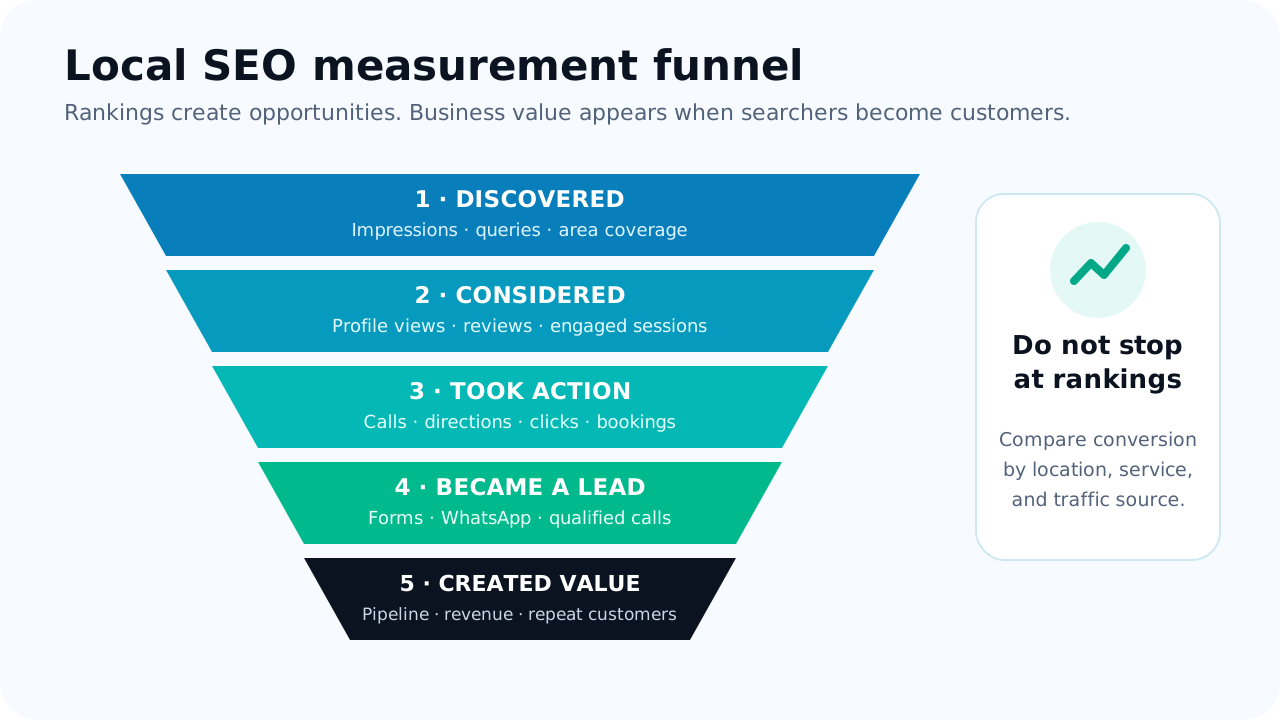
Baselines and reporting rhythm
Capture at least a 28-day baseline before a major change when data is available. For a seasonal business, compare with the equivalent period in the previous year. Annotate category, address, hour, page, tracking, and campaign changes so movement has context.
- Weekly: profile errors, new reviews, data changes, tracking, and incidents.
- Monthly: queries, grid coverage, organic landing pages, profile actions, leads, and conversion rates.
- Quarterly: pipeline contribution, location trends, content gaps, authority, and experiment priorities.
Use simple formulas to read the funnel:
- Profile action rate = profile actions ÷ profile views.
- Website lead rate = local organic leads ÷ local organic sessions.
- Qualified lead rate = qualified leads ÷ all local leads.
- Revenue per location = attributed revenue ÷ active locations.
Not every call or direction request becomes a customer. Define a qualified lead with sales or operations so local SEO reporting does not overstate value. Available Business Profile metrics vary by category. Google’s Business Profile performance documentation covers searches, views, directions, calls, website clicks, bookings, and other eligible interactions.
How to diagnose a local ranking drop
Do not immediately change the category, name, and page at the same time. Diagnose the pattern first:
| Symptom | Possible cause | First check |
|---|---|---|
| Profile disappears for every query | Suspension, verification, major edit, duplicate | Profile status, owner email, Search/Maps |
| Drop occurs only in part of the area | Distance, new competitor, weaker coverage | Grid by point and competitor changes |
| Maps is stable but organic drops | Indexing, intent, content, technical issue, links | GSC page/query, crawl, SERP changes |
| Views are stable but actions decline | Operating data, reviews, CTA, seasonality | Hours, phone, rating, landing page |
| Leads fall while rankings remain stable | Tracking, query quality, sales handling | GA4 events, call logs, CRM, response time |
| One branch rises while another falls | Cannibalization or mixed location data | URL, canonical, profile, NAP, internal links |
Also check seasonality, business-hour changes, relocation, rebranding, website migration, category updates, duplicate profiles, review spam, and competitor changes. Change one group of variables, document the date, and measure again.
How much does local SEO cost?
Cost depends on the number of locations, competitive intensity, website condition, profile quality, content requirements, and reputation work. Engagements usually fall into three models:
- One-time setup: audit, GBP optimization, tracking, and NAP cleanup.
- Monthly retainer: content, citations, review workflow, link earning, monitoring, and reporting.
- Multi-location program: data governance, location-page templates, dashboards, and branch coordination.
A cheap offer that only adds keywords to a profile is not comparable with a program that connects Maps, the website, reputation, analytics, and sales. Compare deliverables and measurement, not price alone.
How to choose a local SEO company
A capable local SEO company should explain what it will do, who will do it, which data it will use, and how the outcome will be evaluated.
Ask these questions:
- Does the audit include GBP, website, citations, reviews, competitors, and tracking?
- How are keywords mapped to services and locations?
- Who retains access and ownership of the profile?
- How are profile changes documented?
- Which KPIs are reported beyond rankings?
- How are calls, directions, forms, leads, and pipeline connected?
- What is the strategy for service-area or multi-location businesses?
- What happens if a profile is suspended or business information changes?
Avoid guaranteed positions, fake locations, incentivized reviews, keyword-stuffed business names, and reports that contain only ranking screenshots. A healthy partner leaves asset ownership with the business and does not promise something Google itself does not sell.
Local SEO for B2B companies
Local SEO is not limited to shops and restaurants. B2B companies that provide installation, support, distribution, consulting, or site visits also have local intent.
Examples include:
- network installation vendor Jakarta;
- CCTV company Surabaya;
- office IT support Tangerang;
- network hardware distributor Indonesia;
- B2B local SEO.
B2B pages should add evidence of capacity: project types, operating region, service levels, survey process, certifications, partners, case studies, and a consultation path. For a high-value decision, proximity opens the door; proof and a clear process create the lead.
Common local SEO mistakes
- Keyword stuffing the business name. It misrepresents the real business and risks correction.
- Creating fake locations. Distance cannot be gamed with an ineligible virtual address.
- Publishing identical city pages. Replacing only a city name creates doorway content.
- Inconsistent NAP. Conflicting data reduces trust and confuses customers.
- Buying reviews or review gating. Both violate policy and damage reputation.
- Chasing citation volume. Random directories rarely help customers or authority.
- Skipping tracking. Rankings rise, but calls, forms, and pipeline remain unknown.
- Measuring from one point. Local positions can change a few kilometers away.
Local SEO with LINC
LINC delivers local SEO as part of a measurable SEO strategy. The workflow begins with an audit of the profile, website, keywords, competitors, citations, reviews, and tracking. Work is then prioritized according to its effect on visibility, customer actions, leads, and the team’s ability to keep information accurate.
Deliverables can include a keyword-to-page map, Google Business Profile optimization, service and location pages, NAP cleanup, a review workflow, local content, internal linking, a dashboard, and an experiment backlog. We do not guarantee a specific position; the aim is an auditable system connected to business outcomes.
Explore the core pillars of SEO, see LINC’s digital marketing services, or schedule a consultation to map your local opportunity.
Frequently asked questions
What is local SEO?
How is local SEO different from regular SEO?
Can a business without a shop use Google Business Profile?
How long does local SEO take?
How much do local SEO services cost?
How do I choose a local SEO company?
Do reviews affect local rankings?
Does LocalBusiness schema improve rankings?
Which tools are needed for local SEO?
How should local SEO be managed across multiple locations?
What should I do when local rankings drop?
Sources and further reading
- Google: Improve your local ranking
- Google: Guidelines for representing your business
- Google: Business Profile eligibility and ownership
- Google: Business Profile categories and services
- Google: Business Profile performance
- Google: Profiles for service businesses
- Google: Tips to get more reviews
- Google Search Central: LocalBusiness structured data
- Google Analytics: Link Business Profile and Analytics
- Ahrefs: Local SEO guide
The bottom line
Local SEO is a system connecting Google Business Profile, the website, location, reputation, and measurement. Start with accurate business data, map keywords to the right pages, earn reviews and citations responsibly, then measure calls, directions, website clicks, leads, and pipeline.
Ranking is an indicator. The outcome is that customers in the right area discover the business, trust it, and act. To identify what is limiting your local growth today, schedule a consultation with LINC.