
Google and AI assistants like ChatGPT share one important trait: both trust businesses that are widely talked about and cited by credible sources. That is where digital PR for SEO comes in. Instead of just chasing awareness, modern digital PR turns media coverage and brand mentions into quality backlinks, domain authority, and citations in AI answers — the signals that move rankings and AI-search visibility alike. This article explains what digital PR is, why it matters now, how to run a campaign step by step, and a full illustrative example with figures in Indonesian Rupiah.
What is digital PR?
Digital PR is the practice of earning online media coverage, brand mentions, and backlinks from trusted publications to build a business’s authority and reputation online. What sets it apart from traditional PR: digital PR treats links (backlinks), domain authority, and citations in AI search as the primary outcome — not a side effect of coverage.
In short, digital PR is where PR and SEO meet. You create a story genuinely worth covering, then design it so every placement also strengthens your position on Google and in AI answers. Traditional PR measures success by coverage volume and awareness; digital PR measures it by quality backlinks, authority growth, organic traffic, and ultimately leads and revenue.
Digital PR vs. traditional PR vs. link building
These three terms are often confused, yet their goals differ:
- Traditional PR focuses on reputation and awareness. Coverage in print, TV, or online is measured by reach and sentiment. Backlinks, if any, are an unplanned bonus.
- Link building focuses on the links themselves for SEO. Some tactics are healthy, but others are risky — paid links, low-quality directories, or link exchanges that can trigger penalties.
- Digital PR takes the best of both: the credibility and storytelling of PR, with the measurable results of SEO. You earn coverage that builds reputation and editorial backlinks that strengthen authority — without the risky tactics.
Put differently, digital PR is link building done the journalistic way: you earn links because your story deserves them, not because you bought them. That is why the results last longer and are far safer under Google’s guidelines.
Why digital PR matters for SEO and AI search
Google rankings are still heavily influenced by authority and quality backlinks, and there is no more credible way to earn them than being covered by relevant media. Digital PR produces editorial backlinks — links journalists give because your story genuinely deserves them, not because they were bought. These are far harder for competitors to replicate and far more valuable to Google than directory or paid links. A single link from a relevant, authoritative outlet can outweigh dozens of low-quality ones.
What is new is AI search. Assistants like ChatGPT, Gemini, and AI Overviews assemble answers from sources they judge credible, and editorial coverage is one of the strongest signals of that credibility. The more often trusted media mention your brand, the greater your chance of being cited directly in AI answers — not just appearing on a results page. This is digital PR’s edge over other link-building tactics: one well-placed story earns you authority for Google and mentions for AI engines at the same time.
There is a third, often-forgotten benefit: trust. When a prospect searches your name and finds coverage in outlets they recognize, the buying decision gets easier. The authority digital PR builds works across the whole customer journey — from discovery on Google, to AI answers, to the final validation before a purchase. That is what sets it apart from advertising: the effect does not stop when you stop paying — it compounds into an asset.
When your business is ready for digital PR
Digital PR is most effective once the foundation is in place. Some signs you are ready:
- Your technical and content foundation is healthy. The backlinks you earn will point to a site that is fast, indexed, and easy to navigate — so the authority actually gets absorbed.
- You have something newsworthy. Internal data, expertise, a unique point of view, or a business moment that interests journalists. Without story material, a campaign stalls.
- You have the capacity to move fast. News moves quickly; a team that can respond to opportunities in days beats one that takes weeks.
- Your goal is long-term authority, not an instant spike. Digital PR compounds like SEO — its value grows over time rather than burning out overnight.
If your site still has fundamental technical issues, fix those first, or run it alongside SEO so every incoming backlink is not wasted. Digital PR accelerates SEO results, but it does not replace a clean foundation.
The digital PR campaign process
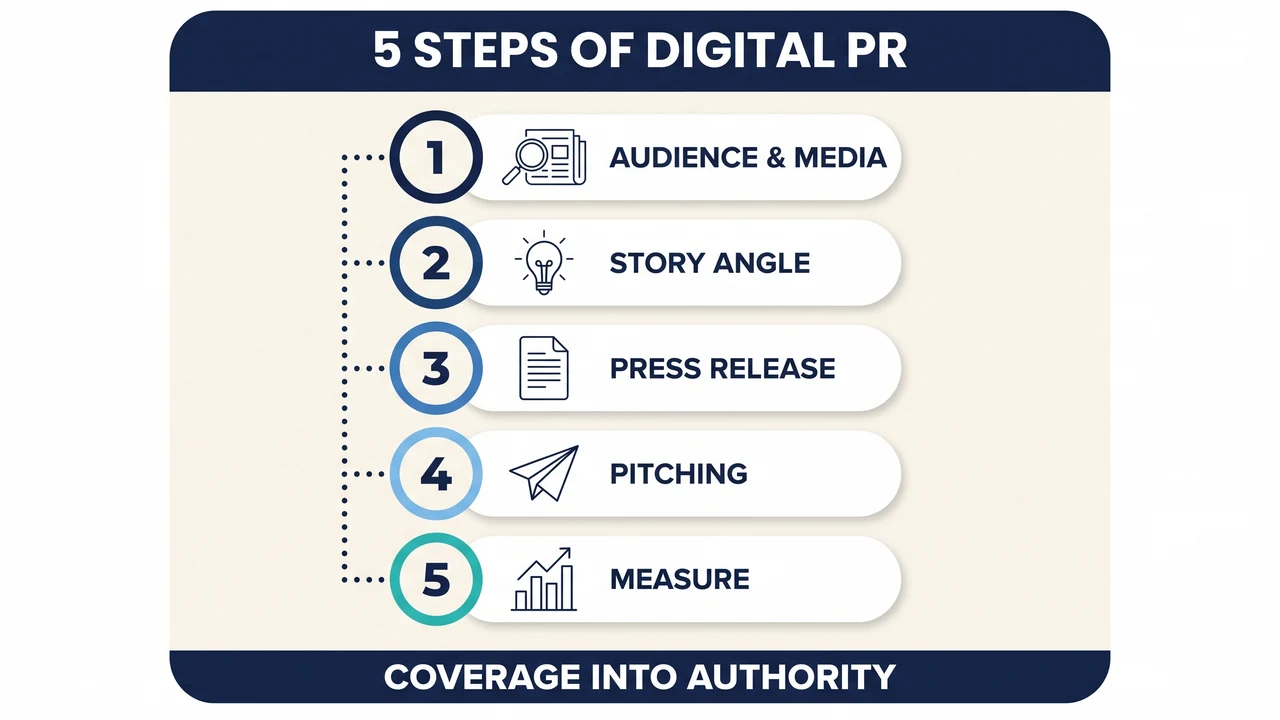
A good digital PR campaign is not about blasting one press release to hundreds of inboxes and hoping. The process is closer to journalism than advertising, and it runs in five stages.
1. Know your audience and the media
Start with who you want to influence, then map where they read. Identify the publications and journalists relevant to your industry — from national outlets like Kontan, Bisnis.com, or Detik to niche and industry blogs in your sector. Study what topics they are covering, their coverage style, and the gaps in the conversation. Note which journalists regularly write about your field — those are your most valuable contacts. The best story angles usually emerge where your expertise meets a question that outlet’s audience is already asking.
2. Find a newsworthy angle
Journalists need a story, not an ad. Angles that tend to work:
- Data studies. Turn internal data or a small survey into a citable finding — a customer-behavior trend or an industry figure no one has published.
- Newsjacking. Add your expert angle to a story that is already hot, while the topic is still current.
- Expert commentary. Offer a leader or specialist as a source on topics you genuinely know well.
- Creative campaigns. An original idea, visual, or piece of research interesting enough to be shared unprompted.
- Business moments. A launch, milestone, partnership, or trend you spotted before anyone else.
One genuinely strong asset is worth more than ten average angles — because a single good story can earn dozens of placements at once. Test your angle with a simple question: would a journalist write about this if it came from someone other than your business? If not, the angle is not strong enough yet.
3. Write the story and the press release
Package your angle into a clear story: a strong headline, one key finding up front, supporting data, a quote from a credible source, and a short boilerplate about your business. Write for a journalist reader, not for a machine — journalists need an angle they can use immediately, not paragraphs of promotional jargon. Include a link to the source page on your site — for example, the full report or a data page — so the link they give points to a valuable asset rather than just your homepage. Prepare supporting assets too, like high-quality charts or images that make it easy for a journalist to publish your story.
4. Pitch to journalists
Send to a targeted list, not a mass blast. The keys to a pitch that lands: a specific, compelling subject line, a concise body that gets to the news value in the first few sentences, and the right timing. Tailor each pitch to that journalist’s past coverage — proof you actually read their work, not a copy-paste to hundreds of addresses. Respect their deadlines and rhythm; offer exclusive access to the data where possible. If there is no response, follow up once politely, then move on to the next target without pushing.
5. Measure results
Measure against outcomes, not activity:
- Business metrics — the leads, sales, and revenue affected. This matters most.
- Quantity metrics — the number of placements, backlinks, and new referring domains earned.
- Quality metrics — the outlet’s domain authority, topical relevance, and the context of the mention (cited as an expert, or just in passing).
- AI-search signals — referrals from ChatGPT and Gemini, and how often your brand appears in AI answers to relevant questions.
Connect each placement to the data in Search Console and GA4 so you can see which campaigns actually move traffic and conversions, not just add clippings.

Tools that help a digital PR campaign
You do not need many expensive tools to start, but a few categories speed up the work:
- Media and journalist research — to find the right contacts and their past coverage.
- Mention monitoring — Google Alerts or similar to track every time your brand is mentioned.
- SEO tools — like Ahrefs or Semrush to monitor backlinks, referring domains, and domain authority.
- Analytics — Google Search Console and GA4 to connect coverage to traffic and conversions.
- AI-search monitoring — check directly how ChatGPT, Gemini, and AI Overviews mention (or miss) your brand.
Tools only speed up the process; what decides the outcome is still the quality of the story and the relevance of the target media. Even a small business can start with free Google Alerts, a spreadsheet of media contacts, and Search Console.
An illustrative example: a digital PR campaign (figures in Rupiah)
Note: the following example is illustrative, to explain how digital PR works — it is not an actual LINC client result. The figures are simplified and in Indonesian Rupiah.
Imagine a B2B fintech platform in Indonesia. Its site is technically healthy, but its authority lags competitors and its name rarely shows up in AI answers. The team runs a data-study campaign: turning anonymized transaction data into a report on SME payment trends, then pitching it to national business media and finance industry blogs. That one report becomes an asset that can be cited over and over — each outlet takes a different figure and links back to the report page.
The illustrative results after a few months:
| Metric (illustrative) | Before → After |
|---|---|
| Revenue per month | Rp 25M → Rp 210M |
| Media placements | ~120 publications |
| Referring domains | ~450 → ~600 |
| Organic traffic | more than 2× |
| AI referrals (ChatGPT/Gemini) | hundreds of visits/month |
| Branded search | +12% |
What matters here is the pattern, not the exact numbers: one newsworthy asset earns many editorial backlinks at once, domain authority rises, rankings for commercial keywords follow, and the brand starts getting cited in AI answers. It all reinforces itself — and because it is authority-based, the effect lasts far longer than paid ads that stop the moment the budget runs out. Note the branded-search lift too: as more people see your name in the media, more of them search for it directly on Google.
Common digital PR mistakes
- Mass pitching with no targeting. Sending one identical press release to hundreds of journalists damages your reputation and is almost always ignored.
- No newsworthy angle. Without a genuinely interesting story, there is no coverage — no matter how hard you push.
- Buying backlinks. Paid links violate Google’s guidelines and risk penalties. Digital PR is the opposite: links are earned because they are deserved.
- Skipping measurement. Without measuring, you cannot tell which campaigns are worth repeating and which waste resources.
- Expecting instant results. Some placements come quickly, but the authority and ranking impact compounds over months, just like SEO.
Digital PR with LINC
LINC runs digital PR not as a separate activity but as part of a coordinated authority strategy — SEO, content, and media mentions work together and are measured against leads and revenue, not just coverage counts. We help find newsworthy angles, build citable assets, and turn that coverage into both search authority and mentions in AI answers. This approach also aligns with SEO, PPC, and social media running as one strategy. Explore LINC’s digital marketing services or book a consultation to discuss the digital PR opportunity for your business.
Frequently asked questions
What is digital PR?
What is the difference between digital PR and a regular press release?
Does digital PR really help SEO?
Which media are a good fit for digital PR in Indonesia?
How long until you see results?
Is digital PR safe (white-hat)?
The bottom line
Digital PR is the most credible way to build authority that Google and AI engines both reward: real stories, covered by trusted media, turning into backlinks and citations that compound. Start with a healthy site foundation, one newsworthy angle, and honest measurement against business results. If you want coverage that genuinely moves search and revenue — not just adds clippings — let’s talk.