Supporting article: Local SEO for Indonesian Businesses
Many teams celebrate a ranking gain, then wonder why leads stay flat. This guide covers how to measure local SEO without guesswork: separate Maps and website signals, set KPIs by goal, install tracking, and read the funnel through qualified leads. For a system baseline, use the local SEO audit. If numbers fall suddenly, open how to diagnose a local SEO ranking drop.
Rankings are not a report
One map-pack screenshot from the office laptop is not a success metric. Local results shift by searcher location, device, personalization, seasonality, and competitors. A useful report answers four questions:
- Is the business found? Views, queries, coverage area, grid position.
- Do people act? Calls, directions, website clicks, bookings, messages.
- Do actions become leads? Forms, WhatsApp, qualified calls, opportunities.
- Do leads become revenue? Pipeline, close rate, revenue per location.
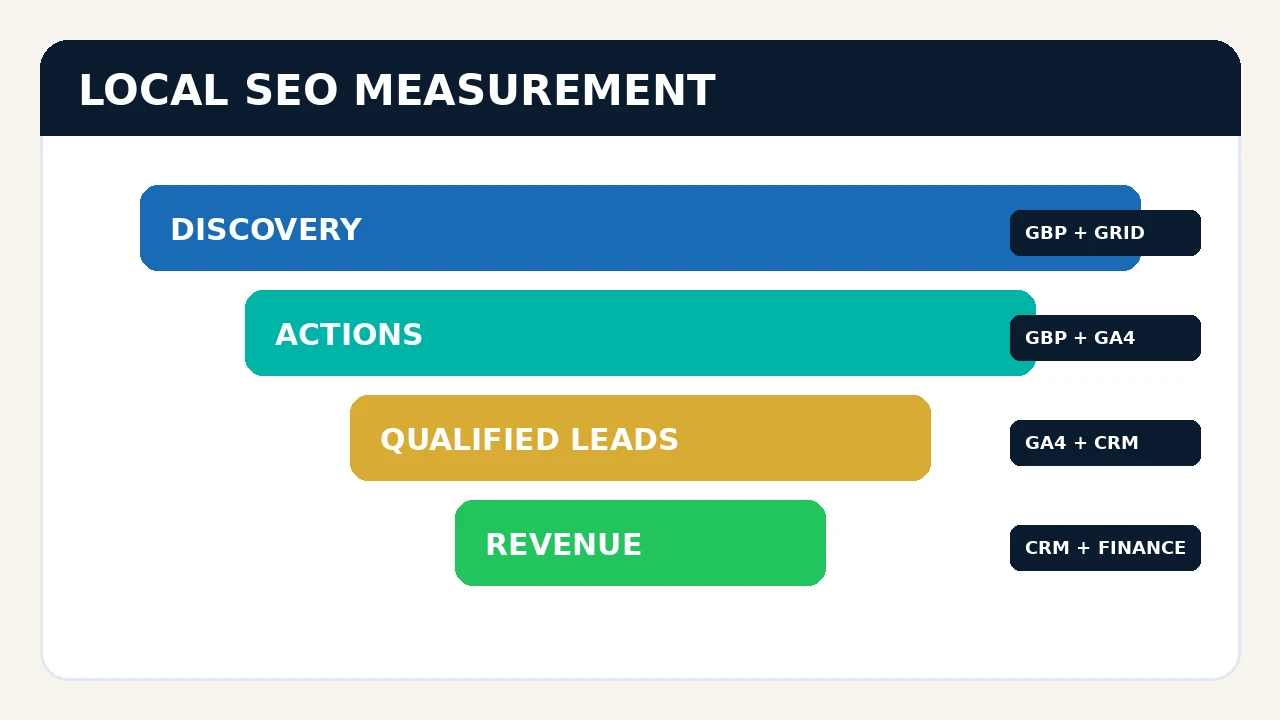
The local SEO measurement funnel
Read the numbers in order. Do not jump from ranking to revenue.
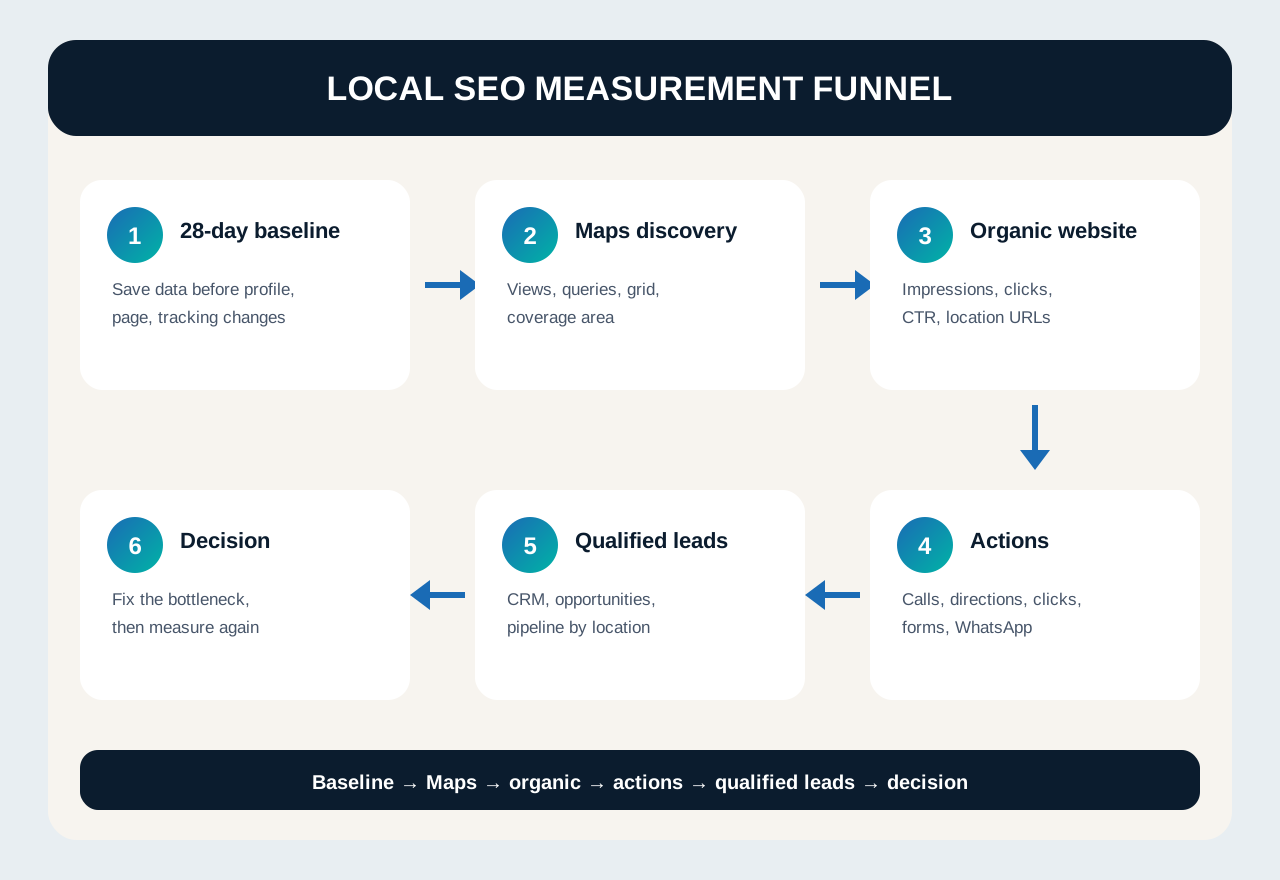
1. Capture a 28-day baseline
Before changing categories, hours, pages, or tracking, save the last 28 days when available. Seasonal businesses should also compare the same period last year. Annotate major changes so movement has context.
2. Measure discovery on Maps
From Business Profile Performance, log search terms, views, and coverage if you use a rank tracker. Keep discovery (found) separate from actions (followed up).
3. Measure organic website performance
Use Google Search Console for impressions, clicks, CTR, and position on service or location pages. Do not dump all organic traffic together; focus on queries and URLs that match the service area.
4. Measure actions
Calls, directions, website clicks, messages, and bookings from the profile. On the site: form submits, WhatsApp clicks, phone clicks. Google supports linking Google Business Profile with Google Analytics for eligible metrics.
5. Measure qualified leads
Define a qualified lead with sales or operations. Not every call or direction request is a customer. Without that definition, local SEO reports overstate value.
6. Decide the next work
Every metric should trigger an action. Views up but actions flat? Fix hours, phone, CTAs, reviews. Organic up but forms broken? Fix the landing page and tracking, not more content.
KPI table and data sources
| Goal | KPI | Source | Decision |
|---|---|---|---|
| Found on Maps | Views, queries, grid coverage | GBP Performance, rank tracker | Category, completeness, area focus |
| Get actions | Calls, directions, website clicks, bookings | GBP, GA4 | CTA, hours, phone, landing page |
| Win organic | Impressions, clicks, CTR, position | Search Console | Content, internal links, index |
| Get leads | Forms, WhatsApp, qualified calls | GA4, CRM, call tracking | Keyword and branch priority |
| Protect reputation | Volume, rating, recency, response time | GBP, review system | Operations and follow-up |
Tracking that must stay clean
Without clean tracking, even rising rankings cannot connect to pipeline.
- UTMs on the GBP website link. Separate profile sessions from ordinary organic. Follow campaign parameters in the Google Analytics docs.
- Form, phone, and WhatsApp events. Log them in GA4, not pageviews alone.
- CRM or lead sheet. Source, branch, query when known, qualified status.
- Careful call tracking. Tracking numbers must not break public NAP without control. See also citations and NAP consistency.
- Change annotations. Date category, address, hours, page, promo, and holiday edits.
Simple formulas
- Profile action rate = profile actions ÷ profile views.
- Website lead rate = local organic leads ÷ local organic sessions.
- Qualified lead rate = qualified leads ÷ all local leads.
- Revenue per location = attributed revenue ÷ active locations.
These are not universal targets. Use them to compare periods, branches, and experiments inside the same business.
Reporting rhythm
- Weekly: profile errors, new reviews, broken tracking, phone or hours incidents.
- Monthly: queries, grid coverage, organic landing pages, profile actions, leads, conversion rates.
- Quarterly: pipeline by location, content gaps, authority, 90-day experiment priorities.
Profile optimization still gets its own tracking path in how to optimize Google Business Profile.
Common measurement mistakes
- Judging success from one manual office search.
- Mixing Maps, organic, ads, and direct into one “local traffic” number.
- Counting every call as a lead without qualification.
- Changing 10 GBP fields, then claiming one metric “won because of X.”
- Skipping UTMs, then blaming SEO when profile form traffic is invisible.
- Comparing branches without normalizing hours, inventory, or sales capacity.
A 60-minute setup checklist
- Export 28 days of GBP Performance.
- Export 28 days of Search Console queries and pages.
- Check UTMs on the profile website link.
- Test form, phone, and WhatsApp events in GA4.
- Define a qualified lead with sales (one paragraph).
- Build a sheet: branch, KPI, baseline, decision target.
- Annotate the last five business changes.
- Pick three primary KPIs, not 20 vanity metrics.
- Schedule a 20-minute weekly review.
- Save a dashboard screenshot as a visual baseline.
Conclusion
Useful local SEO measurement separates discovery, actions, leads, and revenue. Rankings are only an early signal. Install tracking, set KPIs by goal, report on a rhythm, and decide work from the data. Once measurement is stable, use the Local SEO guide for execution priorities.
Need a dashboard and backlog tied to pipeline? See LINC digital marketing services or contact the team.