Supporting article for the main guide: Local SEO for Indonesian Businesses: Complete 2026 Guide
Many local businesses fail at the first step: they collect city names, then insert a service. The result is thin pages, wrong intent, and keywords the team cannot fulfill. This guide covers practical local SEO keyword research: start from services and customer problems, add local modifiers, inspect search results, validate demand, and map keywords to URLs. The broader framework lives in the Local SEO guide for Indonesian businesses; after keywords are mapped, continue with location pages and Google Business Profile.
How local keyword research differs from general SEO research
General SEO research often chases national volume. Local SEO keyword research targets demand in areas you can actually serve, plus intent that surfaces Maps, service pages, or location pages.
Google personalizes local results by user location, language, and nearby business signals. A “good keyword” is not only high volume. It should:
- match a service you sell;
- fit your operating area or branch coverage;
- show local competitors in the SERP;
- deserve a specific page, not a generic homepage.

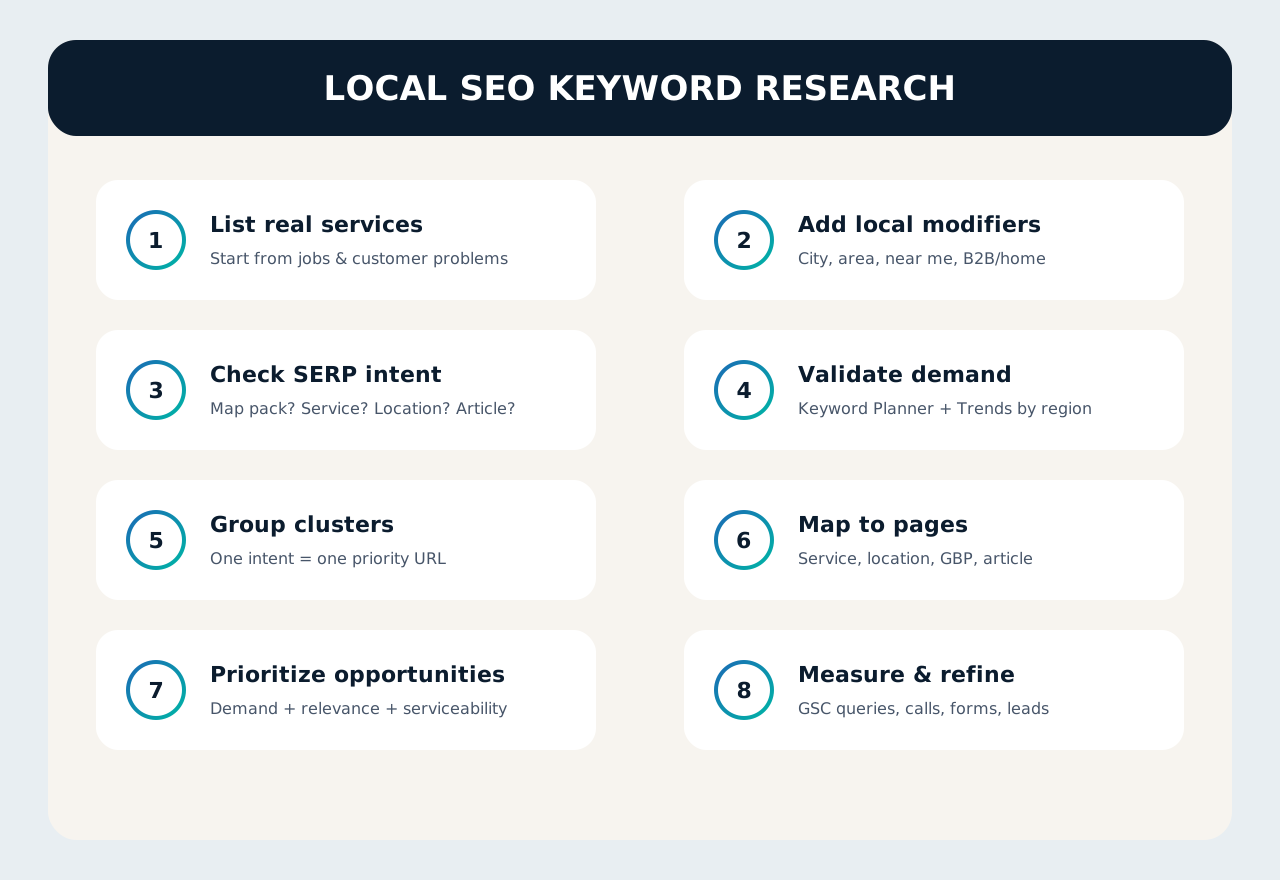
An 8-step workflow
Use this workflow for single-location and multi-branch businesses.
1. List real services and problems
Start with what you sell, not a city map. Separate installation, repair, rental, audit, and maintenance when the message and CTA differ. Capture customer language from WhatsApp, call logs, and forms.
2. Add local modifiers
Combine each service with city, district, neighborhood, “near me,” “nearby,” customer type (home, office, factory), and buying stage (price, vendor, service). Examples: office CCTV installation South Jakarta, cafe WiFi vendor Bandung.
3. Check SERP intent
Search from the target location. Is there a map pack? Do homepages, service pages, location pages, directories, or articles dominate? SERP intent decides the page type you need—not internal preference.
4. Validate demand
Use Google Keyword Planner with location targeting, not only “Indonesia.” Compare terms in Google Trends by region. Low volume in a smaller city is not automatically weak if commercial intent is clear.
5. Group clusters
One intent + one service + one primary answer = one priority URL. Do not split CCTV service Jakarta and CCTV installation Jakarta into two thin pages when the SERP is the same.
6. Map clusters to page types
- Service page: service/vendor intent without a branch focus.
- Location page: branch/area intent with local proof.
- GBP: “near me” and Maps navigation intent.
- Article: education/implementation intent, not pure transaction.
7. Prioritize opportunities
Score demand, relevance, serviceability, and competitor gaps. Keywords for areas you cannot serve create false traffic and misleading content risk.
8. Measure and refine
After launch, review GSC queries, calls, directions, forms, and leads. Queries that appear without a matching page become the next research backlog.
Example keyword-to-URL mapping
| Cluster | Example keywords | Best page |
|---|---|---|
| Education | what is local SEO, local keyword research | Guide article |
| Service | local SEO services, office CCTV vendor | Service page |
| Location | local SEO South Jakarta | Unique location page |
| Implementation | Google Business Profile optimization, NAP audit | Focused article / checklist |
| Near me | AC service near me | GBP + website contact/location |
A 30-minute seed keyword template
- Write 5–10 core services.
- Write 3–5 customer problems per service.
- Add 3 priority areas you truly serve.
- Build service × area × intent combinations.
- Drop combinations you cannot serve or that lack local SERPs.
- Mark existing URLs versus new URLs needed.
Common mistakes
- Mass-producing city pages without local proof (doorway risk).
- Chasing national volume for a 10 km service radius.
- Merging installation and repair on one page when intent differs.
- Copying competitor keywords for services or categories you do not offer.
- Ignoring customer language from chat and call logs.
- Failing to connect keywords to consistent NAP, profile, and citations—see the citations & NAP guide.
Execution checklist
- Service and customer-problem seed list complete.
- Local modifiers limited to serviceable areas.
- Primary seeds have SERP intent notes.
- Clusters mapped to existing URLs or content backlog.
- “Near me” keywords aligned with GBP categories and services.
- Success metrics defined: GSC queries, calls, directions, leads.
Conclusion
Good local SEO keyword research maps demand to pages that answer searcher intent in areas you can serve. Start with services, validate intent, group clusters, then build pages—not the reverse. For the full local SEO framework, return to the Local SEO guide for Indonesian businesses.
Need help building a local keyword and page map? See LINC’s SEO services or contact our team.