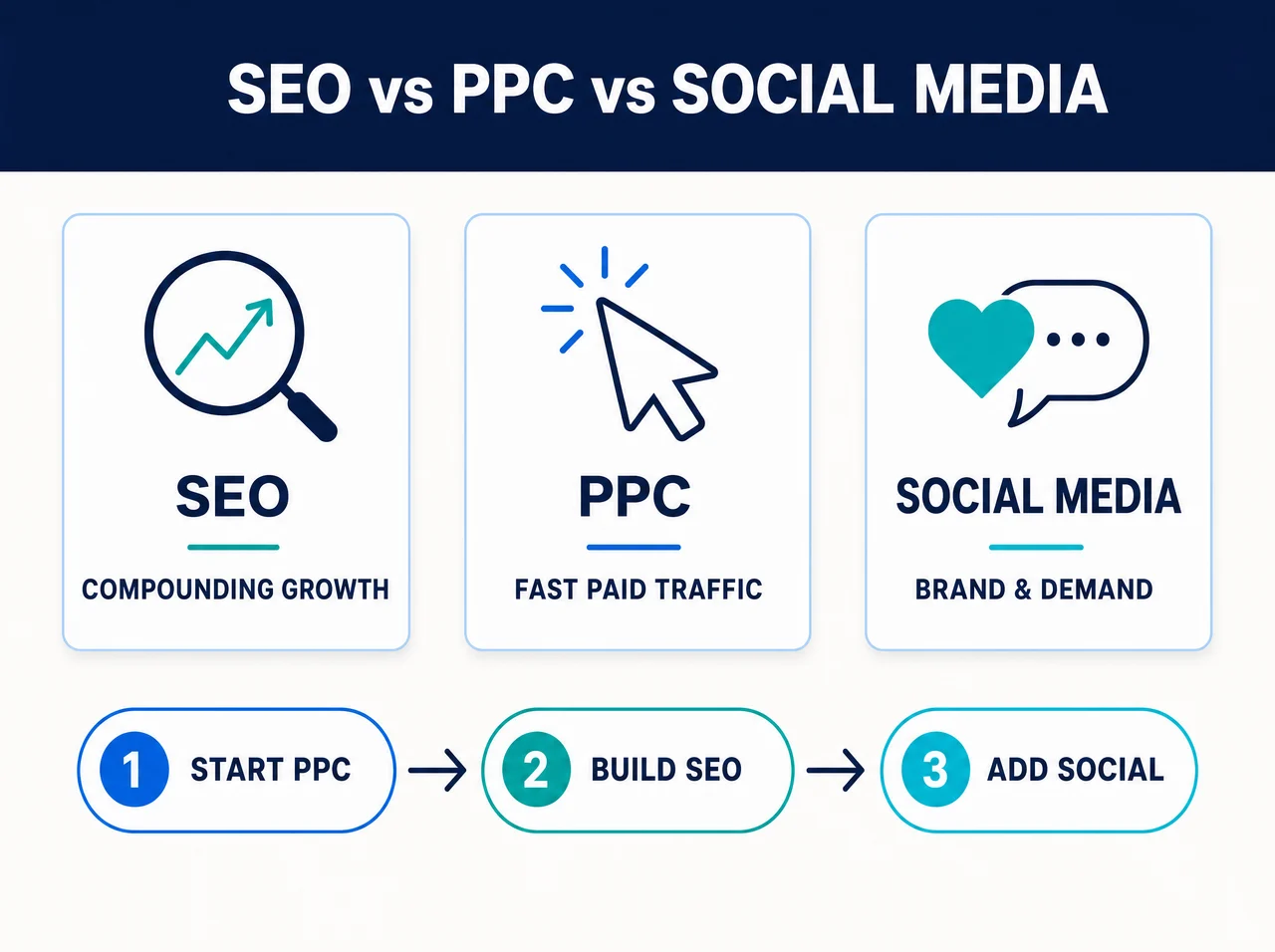
Most businesses do not have a “digital marketing” problem in general. The problem is more concrete: “where should the next dollar go?” Into search engine optimization (SEO), pay-per-click advertising (PPC), or social media marketing (SMM)? All three can bring in customers, but they work on different timelines, use budget in different ways, and suit different goals.
This guide breaks down the SEO vs. PPC vs. social media comparison: what each one is good at, where its limits are, and how to decide which channel most deserves budget first. The short version: for most growing companies, the answer is not a single channel but the right sequence of all three. Here is how to get there without wasting spend.
What does digital marketing cover?
Digital marketing is an umbrella term for all the online channels used to reach customers. The three channels that usually anchor a budget are:
- SEO — earning free or organic visibility on search engines like Google.
- PPC — paying for placement, usually on Google Ads or social platforms, and then paying again each time someone clicks.
- Social media marketing (SMM) — building an audience and a brand on platforms like Instagram, Facebook, TikTok, and LinkedIn, whether organically or through paid ads.
Email marketing, content marketing, and conversion rate optimization round out the bigger picture. But SEO, PPC, and social are usually the starting point for the “which should I choose” question. Let’s go through them one by one.
SEO: long-term growth that compounds
What is SEO?
Search engine optimization is the practice of improving your website so it ranks higher in organic search results for the terms your customers type into Google. When someone searches for “SMS gateway service Jakarta” or “ERP implementation Indonesia” and finds your business without you paying for that click, SEO is working.
How it works
SEO rests on three pillars. On-page SEO aligns titles, headings, and content with what searchers need. Technical SEO makes the website fast, easy to crawl, and easy to index. Off-page SEO builds authority through backlinks and citations from other trusted websites. Google rewards pages that genuinely answer a query better than the alternatives.
Strengths
- Compounding returns. A page that ranks can keep bringing in traffic month after month with no cost per click.
- Trust and high intent. Users who are actively searching are usually closer to a decision, and organic results often feel more credible than ads.
- Lower long-term cost per lead once rankings are established.
Weaknesses
- Slow. Meaningful results usually take six to twelve months, especially for new domains.
- No guarantees. Algorithm updates and competitors can shift rankings.
- Resource-intensive. SEO demands consistent content, technical maintenance, and link building.
Best for
Businesses playing the long game, that want sustainable and cheaper lead generation and can wait for results to build — especially local SEO for service businesses targeting a specific city or region.
PPC: fast traffic that you pay for
What is PPC?
Pay-per-click advertising puts your business at the top of search results or social feeds instantly, and you pay each time someone clicks. Google Ads is usually the most common starting point, along with paid campaigns on Meta (Facebook and Instagram).
How it works
You bid on keywords or audiences, write your ads, and set a daily budget. In search, your position is determined by your bid and your Quality Score, which is Google’s measure of how relevant your ad and landing page are. Better relevance means a lower cost-per-click. Campaigns can be switched on, paused, and adjusted in real time.
Strengths
- Fast. Traffic and leads can arrive the same day a campaign launches.
- Precise targeting. Reach people by keyword, location, device, interest, and more.
- Measurable. Every click, conversion, and cost can be tracked, making ROI easier to calculate and optimize.
Weaknesses
- Every visit is paid. When the budget stops, the traffic stops.
- Costs rise with competition. Crowded keywords can get expensive.
- Needs management. Wasted spend piles up quickly without ongoing optimization and good landing pages.
Best for
Businesses that need leads now: launching a new product, running a seasonal promotion, or filling the pipeline while SEO builds in the background.
Social media marketing: demand creation and brand
What is social media marketing?
Social media marketing builds your brand and audience on the platforms where people spend their time. Unlike search, social does not capture people who are already looking for you. Social creates demand and keeps your brand top of mind.
How it works
You publish content that earns engagement (organic), run paid ads to extend reach (paid social), or both. Algorithms reward content that makes people stop, react, and share it. Over time you build a following, a brand voice, and a channel for promotion, support, and social proof.
Strengths
- Brand awareness and loyalty. Social is where relationships and reputation are built.
- Powerful paid targeting. Meta’s ad tools can reach precise audiences at a relatively cheap awareness cost.
- Social proof. Reviews, comments, and shares build trust that supports your other channels.
Weaknesses
- Lower purchase intent. Most people on social are not ready to buy in that moment.
- Needs constant content. Organic reach is declining, so consistent posting is required to stay visible.
- Harder attribution. The impact on sales is real, but not as direct to measure as PPC.
Best for
Businesses building a brand, launching to a broad audience, selling visual products, and any company that wants to nurture an audience between purchase cycles.
SEO vs. PPC vs. social media: a head-to-head comparison
| Factor | SEO | PPC | Social Media |
|---|---|---|---|
| Speed of results | Slow (6-12 months) | Instant | Moderate |
| Cost model | Time and content up front | Pay per click, ongoing | Time (organic) or ad spend |
| Longevity of results | Compounds and lasts | Stops when the budget stops | Builds over time |
| Buyer intent | High (actively searching) | High (actively searching) | Lower (passively discovering) |
| Strongest for | Sustainable lead generation | Quick wins and scaling | Brand, awareness, loyalty |
| Main risk | Slow, algorithm changes | Rising costs, wasted spend | Time-intensive, hard attribution |
How to measure each channel
You cannot optimize something you do not track. Each channel has its core metrics:
- SEO: organic traffic, keyword rankings, impressions and clicks from Google Search Console, plus conversions from organic visits. Authority signals like referring domains matter over time.
- PPC: click-through rate (CTR), cost-per-click (CPC), conversion rate, cost per acquisition (CPA), and return on ad spend (ROAS). Quality Score shows how efficiently you are buying clicks.
- Social media: reach, impressions, engagement rate, follower growth, and for paid social, the same CPC, CPA, and ROAS metrics as PPC.
Set up tracking before you spend: Google Analytics 4 for behavior and conversions, Google Search Console for organic performance, and the native Google Ads and Meta dashboards. Then connect each channel to business outcomes like leads, sales, or qualified inquiries — not vanity metrics. A channel that brings 1,000 visits and zero leads loses to a channel that brings 100 visits and ten leads.
So which should you choose?
There is no single best channel for every situation. There is a best sequence for your circumstances, and the following three questions determine it.
How fast do you need results? If you need leads this month, start with PPC. It is the only channel that can run immediately.
What is your budget, and is it recurring? PPC needs ongoing budget; the day the budget stops, the leads stop. SEO is a heavier up-front investment but pays back over time. If cash flow is tight, a small PPC budget plus a consistent SEO foundation is a sensible split.
What is your timeline and goal? For long-term growth at a lower cost, SEO is the foundation. For building a brand and an audience, social media does what search cannot.
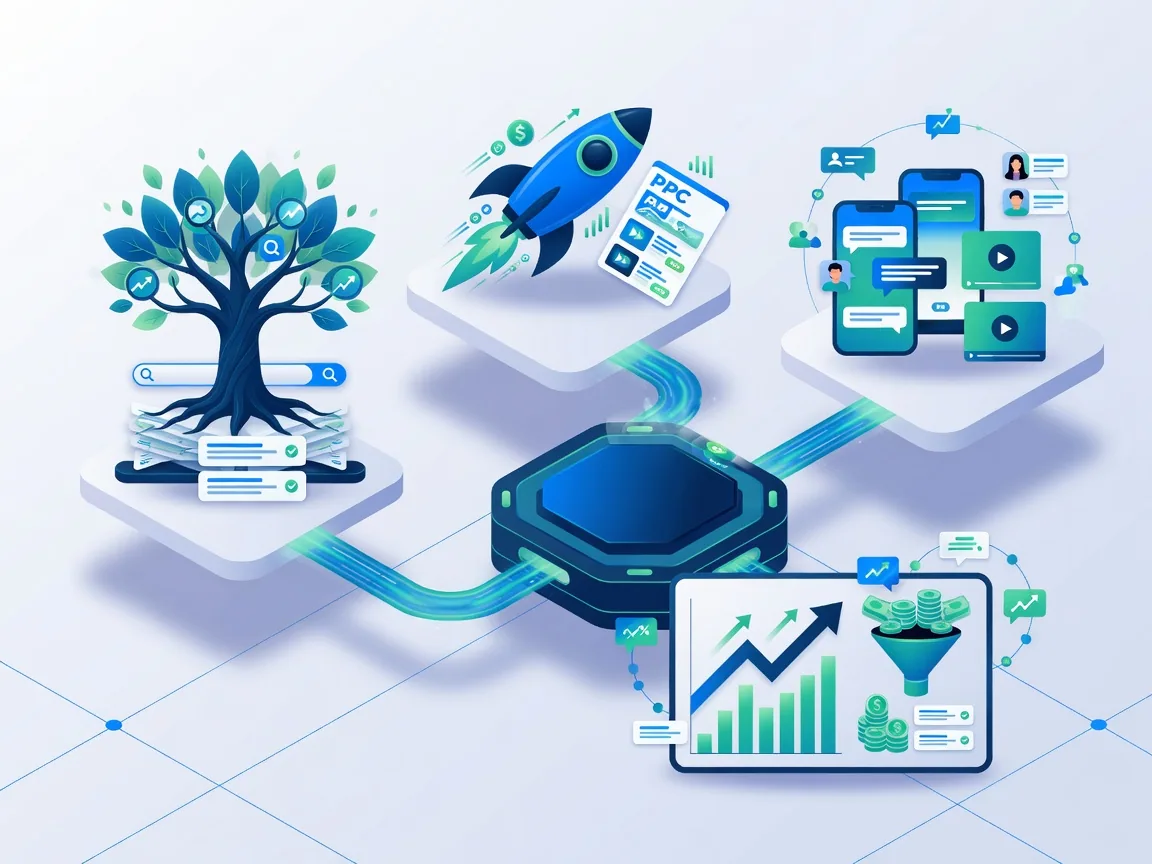
For most small and medium businesses, the smartest move is to layer all three rather than pick one:
- Start with PPC to generate leads while the other channels build.
- Invest in SEO in parallel for durable, compounding traffic, especially local SEO.
- Use social media to build the brand, trust, and audience that support both.
These channels reinforce one another. SEO and PPC together let you own more of the search results page and share keyword data. Social proof makes your ads and organic listings more convincing. Run well, the combined result is greater than each channel on its own.
Common mistakes that waste budget
A few genuinely avoidable mistakes regularly drain digital marketing budgets:
- Treating the channels separately. Running PPC, SEO, and social as three separate efforts creates duplicated work and no shared learning. Keyword data from PPC should feed SEO; social proof should feed your ads.
- Expecting instant SEO. Stopping SEO in the third month, right before results start to compound, wastes the entire investment.
- Sending ads to weak landing pages. Paying for clicks that land on a slow or unconvincing page burns money. Page speed and a clear CTA matter as much as the ad itself.
- Chasing vanity metrics. Followers and impressions feel good, but they do not pay invoices. Optimize for leads and revenue.
- No tracking. Without GA4, Search Console, and conversion tracking, you are just guessing. Measurement is the first step, not the last.
- Ignoring local and mobile. Most Indonesian customers search on their phones, often locally. A website that is slow on mobile or invisible for “[service] + [city]” queries leaves a big opportunity on the table.
Where LINC stands
Coordinating SEO, PPC, and social as one strategy — rather than three separate efforts — is where many businesses lose time and money. LINC’s digital marketing services cover SEO and technical SEO, Google Ads and Meta Ads, PPC campaign management, and website optimization, run by one accountable team and tracked against real business outcomes. If you would rather focus on running your business than stitching channels together one by one, schedule a consultation and LINC will map out the right mix for your goals and budget.
Frequently asked questions
Is SEO or PPC better for a small business?
How long does SEO take to show results?
Can SEO, PPC, and social media run at the same time?
What is the ideal digital marketing budget?
What is the difference between social media marketing and social media ads?
Which channel gives the best ROI?
The bottom line
SEO, PPC, and social media are not competitors fighting over a budget. They are tools for different jobs. PPC buys speed. SEO builds the foundation. Social builds the brand. Choose your first move based on how fast you need results and what you can sustain, then layer in the other channels as the business grows. Run together and tracked properly, they compound into something no single channel could achieve alone.