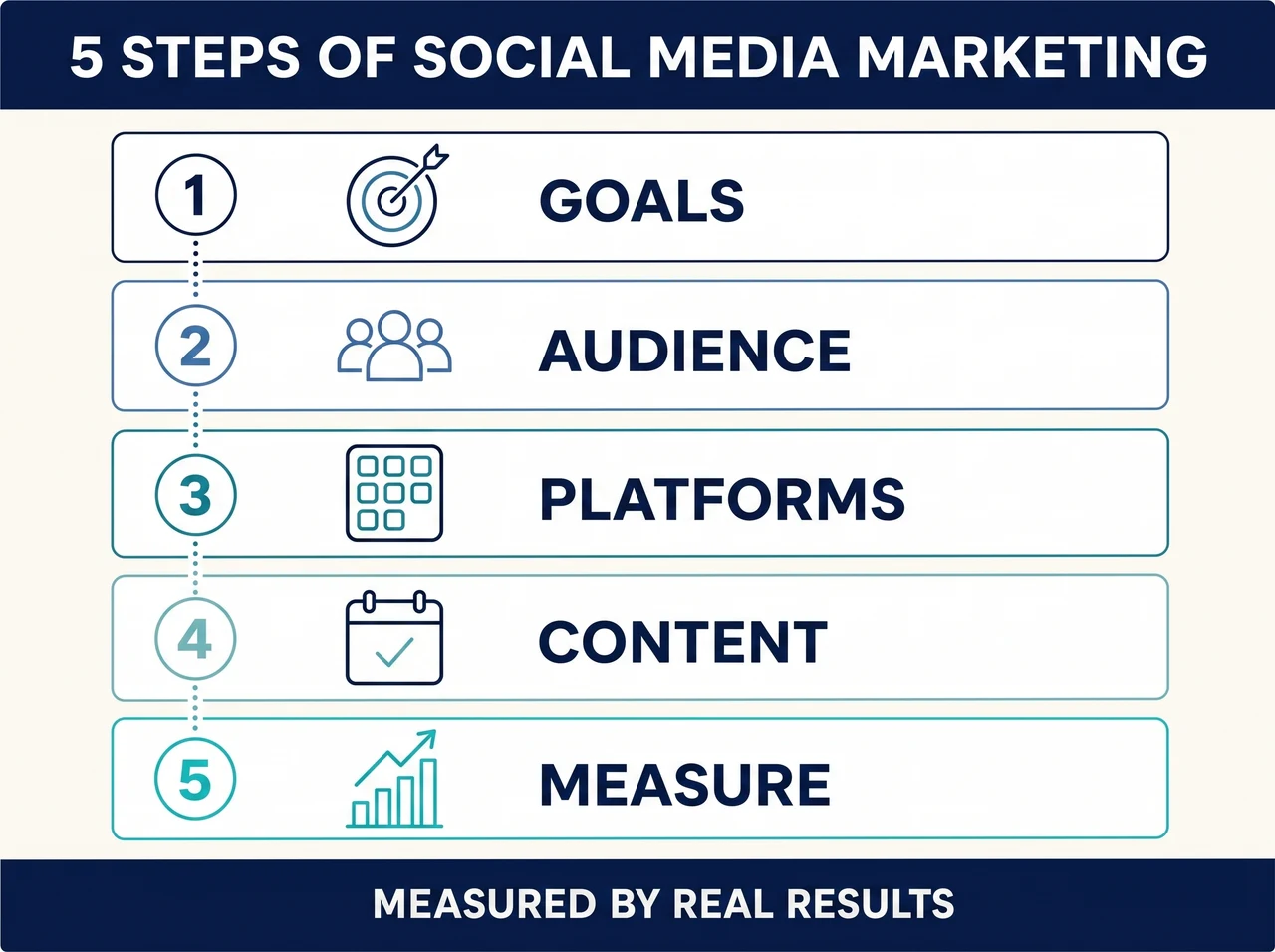
Social media marketing is the use of social platforms to build a brand, reach an audience, create demand, and produce business outcomes. It combines strategy, content production and distribution, community engagement, paid advertising, and measurement through to leads and sales.
That makes it different from simply posting regularly. A business can publish every day and still achieve little if it does not know who it needs to reach, what action it expects, or how that action will be measured.
The opportunity in Indonesia is significant. DataReportal’s Digital 2026: Indonesia reported 180 million social media user identities in October 2025, equal to 62.9% of the population. These are user identities rather than necessarily unique individuals, but the scale still shows how central social media has become to the customer journey.
This guide covers the complete system: how social media marketing works, its goals and components, platform selection, audience research, strategy, content, paid distribution, KPIs, costs, tools, examples, and the connection between social activity, websites, WhatsApp, CRM, and revenue.
Editorial note: this guide was written by George Vie, Head of Digital Marketing at LINC, based on practical work with campaign planning, content workflows, paid distribution, funnel tracking, and performance review. Platform definitions and metrics were checked against primary documentation from Meta, Google Analytics, LinkedIn, and TikTok. Campaign examples are labelled as illustrative when they are not based on publishable client data. Last reviewed and updated on July 28, 2026.
What is social media marketing?
Social media marketing is the process of using platforms such as Instagram, Facebook, TikTok, LinkedIn, YouTube, and X to achieve marketing and business objectives.
Its activity falls into two broad categories:
- Organic social: content and interaction that do not pay the platform for distribution.
- Paid social: advertising that pays the platform to deliver a message to selected audiences.
The two work best as one system. Organic content builds identity, trust, and social proof. Paid distribution expands reach beyond existing followers and accelerates testing. Websites, landing pages, WhatsApp, forms, and CRM then turn attention into conversations and sales opportunities.
Social media marketing is also broader than social media management. Management focuses on day-to-day operations such as scheduling posts, replying to comments, managing inboxes, and producing reports. Marketing includes market research, positioning, campaigns, paid media, conversion, and the contribution to revenue.
How does social media marketing work?
Think of it as a journey rather than a single post:
- Earn attention. Content appears in feeds, platform search, recommendations, or ads.
- Create relevance. The audience recognizes a problem, goal, or point of view that matters to them.
- Generate interaction. People watch, save, share, comment, follow, or visit the profile.
- Prompt an action. They open the website, send a DM, start a WhatsApp chat, submit a form, or buy.
- Follow up. Sales teams or automated systems respond and record the opportunity.
- Measure the result. Platform, website, advertising, CRM, and sales data guide the next decision.
The simplified flow is:
content → reach → engagement → click or conversation → lead → sale → retention
Each stage needs a different message and metric. Educational content may not produce an immediate sale, but it can help buyers understand the problem and available options. A case study reduces doubt. A demo or offer turns intent into action. Judging all social activity by likes is therefore like judging a sales team only by the number of calls made.
The five core components of social media marketing
1. Strategy
Strategy defines who you need to reach, what change you want to create, which platforms you will use, the message you will repeat, and how success will be measured.
A useful strategy can be summarized in one sentence:
We help [audience] understand or achieve [outcome] through [content type] on [platform], then direct them toward [business action].
For a B2B software company:
We help operations managers recognize the cost of manual processes through education and case studies on LinkedIn, then direct them to a systems consultation.
2. Planning and publishing
Good ideas still need a production system. Teams must define content pillars, formats, frequency, ownership, approval, and publishing schedules.
A calendar is not the final goal. Its purpose is to give each piece a role, provide enough production time, and stop the feed from becoming a list of disconnected promotions.
3. Social listening and community management
Social media is a two-way conversation. Social listening monitors:
- Questions and complaints
- Brand mentions, including untagged mentions
- The language customers use
- Competitor activity
- Sentiment changes
- Emerging formats and topics
Community management turns those signals into action by replying, resolving issues, routing leads, and maintaining relationships. Response quality and speed can matter more than posting volume.
4. Analytics and optimization
Analytics should answer three questions:
- Which content earns attention?
- Which audiences take action?
- Does that action create business value?
Platform data reveals reach, watch time, saves, shares, and clicks. Google Analytics 4 shows what happens after a visitor reaches the website. CRM and sales records show whether a lead becomes revenue.
5. Paid advertising
Paid social accelerates distribution by targeting audiences based on location, demographics, interests, behavior, profession, previous engagement, or permitted customer data.
Advertising does not replace strategy. Paying to distribute a weak message only wastes budget faster. A healthy campaign still needs a clear offer, relevant creative, a convincing landing page, reliable tracking, and timely follow-up.
Goals and benefits of social media marketing
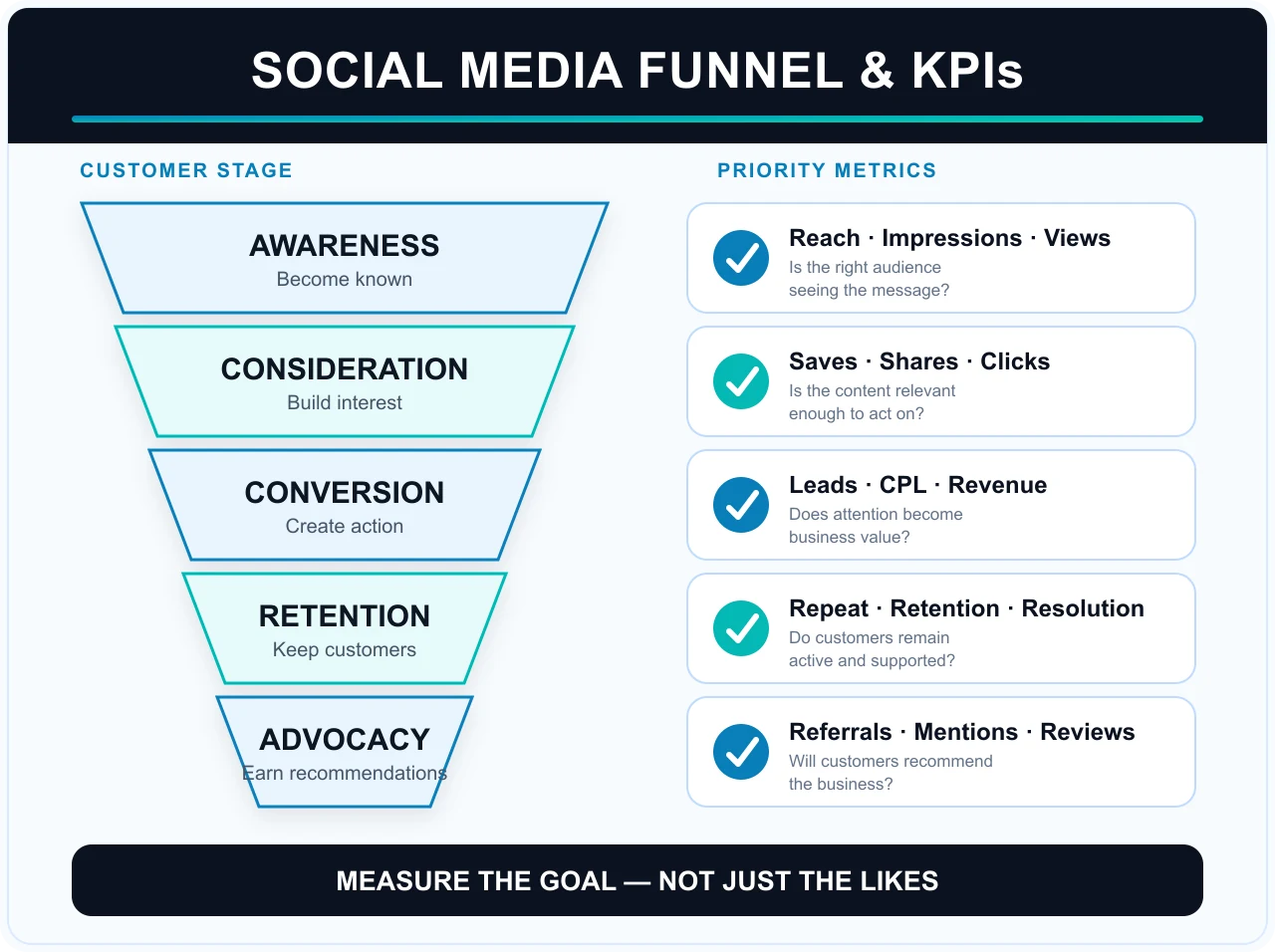
Match the goal to the customer’s stage:
| Stage | Goal | Example activity | Primary metrics |
|---|---|---|---|
| Awareness | Introduce the brand or problem | Educational video, insight, collaboration | Reach, impressions, views, share of voice |
| Consideration | Build trust and interest | Carousel, webinar, comparison, case study | Saves, shares, profile visits, engaged sessions |
| Conversion | Generate leads or sales | Offer, demo, catalogue, click-to-WhatsApp | Leads, conversion rate, CPL, revenue |
| Retention | Keep customers active | Tutorials, community, product updates | Repeat engagement, retention, repeat purchase |
| Advocacy | Encourage recommendations | UGC, referral, testimonial | Mentions, reviews, referral leads |
| Support | Resolve customer issues | DMs, comments, social care | Response time, resolution rate, satisfaction |
The business benefits can include:
- Reaching new potential customers
- Shaping brand perception and positioning
- Generating website traffic, DMs, WhatsApp conversations, and leads
- Strengthening trust through social proof
- Collecting market insight in real time
- Supporting customer service and retention
- Reinforcing SEO, PPC, events, sales, and other campaigns
Organic vs. paid social media
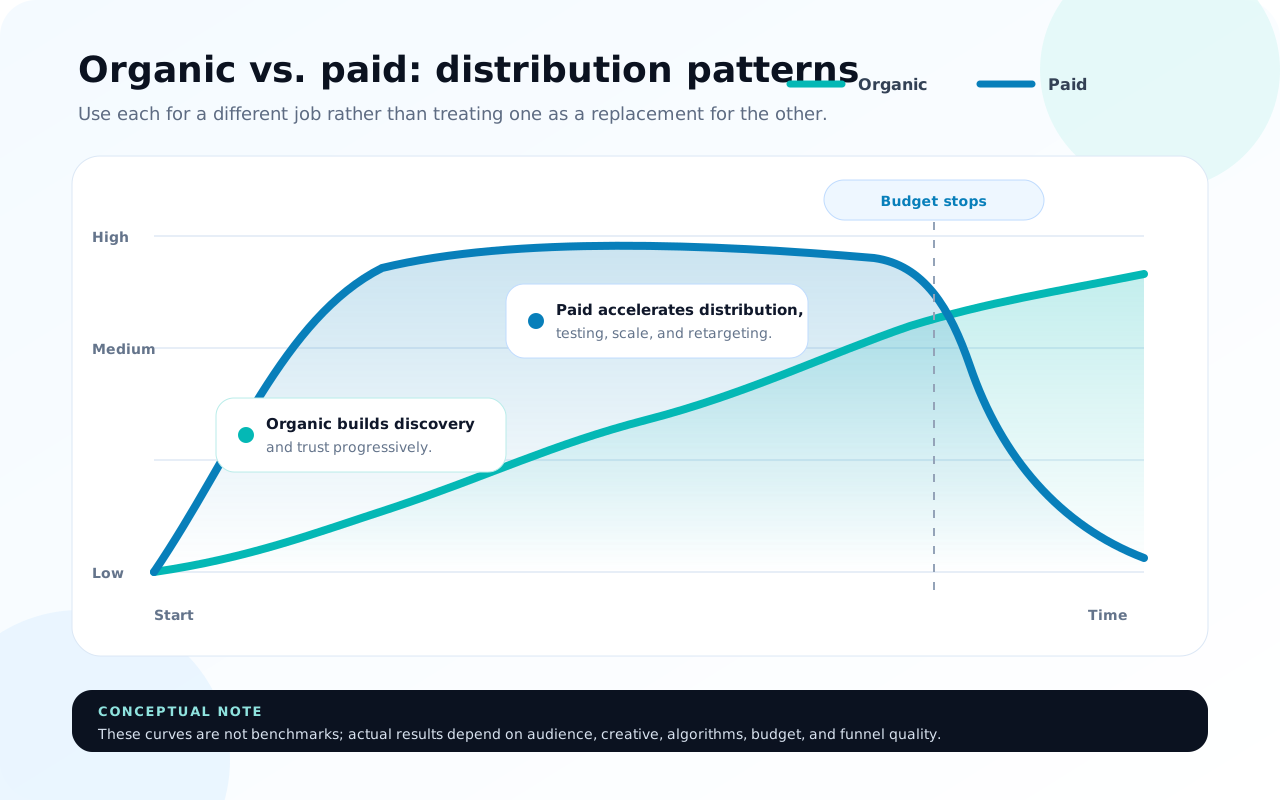
Organic and paid social play different roles.
| Factor | Organic | Paid |
|---|---|---|
| Distribution | Followers, search, shares, and recommendations | Purchased against audience and budget |
| Speed | Builds gradually | Can start immediately |
| Primary role | Trust, community, brand, and education | Reach, retargeting, leads, and scale |
| Cost | No media spend, but still requires people and production | Production cost plus media spend |
| Audience control | Limited | More precise |
| Result lifetime | Useful content may continue to be discovered | Distribution falls when spend stops |
| Main risk | Slow or inconsistent growth | Wasted spend when the message or funnel is weak |
A practical sequence is:
- Test messages and formats organically.
- Identify content that attracts meaningful responses.
- Use paid distribution to expand reach or retarget interested audiences.
- Move the audience toward assets the business controls: website, email, WhatsApp, or CRM.
Social media rarely works alone. It helps create demand and social proof, while SEO and PPC capture demand when buyers start actively searching.
How to choose social media platforms
The best platform is not simply the largest. It is where the audience, the team’s production capability, and the business objective intersect.
| Platform | Strength | Suitable for | Important formats | Typical action |
|---|---|---|---|---|
| Visual brand and community | Retail, F&B, beauty, lifestyle, services | Reels, carousels, Stories, DMs | Profile visit, DM, WhatsApp | |
| Broad age reach, groups, mature ads | Local businesses, communities, B2C | Video, images, groups, live | Message, website, store | |
| TikTok | Discovery and short video | Demonstrable products, accessible education, younger audiences | Native video, creator content, live | Profile, shop, website |
| Professional and B2B context | Technology, professional services, recruitment | Insight, documents, video, case studies | Lead form, demo, consultation | |
| YouTube | Deep education and search | Complex products, tutorials, thought leadership | Long video, Shorts, live | Subscribe, website, demo |
| X | Real-time conversation | News, technology, niche communities | Threads, replies, updates | Follow, discussion, website |
| Conversation and follow-up | Most businesses in Indonesia | Chat, catalogue, permission-based broadcast | Consultation, transaction, support |
Ask three questions:
- Are your potential customers genuinely active there?
- Can your team produce the platform’s formats consistently?
- Does the platform provide a realistic route to a business action?
Start with one primary platform and one supporting platform. Running two channels well is usually better than opening five accounts without enough capacity to create and respond.
How to understand your target audience
Demographics explain who people are, but not why they act. Research should include:
- The problem they want to solve
- The trigger that starts their search
- Their objections and perceived risks
- The words they use to describe the problem
- Platforms and formats they consume
- People who influence the decision
- A realistic next action after seeing content
Useful sources include:
- Sales calls and WhatsApp questions
- Comments, DMs, reviews, and support tickets
- Search queries from Google Search Console
- Page and conversion-path data from GA4
- Customer interviews and polls
- Community conversations
- Competitor content and audience responses
For example, an operations manager at a mid-sized company may struggle with delayed reports and scattered spreadsheets. Their concern is that implementation will cost too much or disrupt operations. They need checklists, comparisons, process demonstrations, and case studies—not generic motivational posts.
A persona is useful only if it changes what the team creates.
How to build a social media marketing strategy
1. Set one primary business objective
Do not start with “grow followers.” Start with a result such as:
- Generate 30 qualified inquiries per month
- Increase webinar registrations
- Reduce repeated support questions
- Build awareness in a new industry
Follower growth can support the objective, but it is not the objective itself.
2. Select an audience and problem
Choose one primary segment per campaign. Content for a small-business owner differs from content for an enterprise IT director, even when both could buy the same product.
3. Define the main message
Clarify:
- The problem you want the brand to own
- The point of view that differentiates the business
- The evidence supporting the message
- The next action after the audience agrees
4. Assign a role to each platform
Reuse ideas, not raw posts:
- LinkedIn: business insight and implications
- Instagram: concise visual education
- TikTok or Reels: hooks, demonstrations, and quick answers
- YouTube: in-depth explanation
- WhatsApp: conversation and follow-up
5. Build content pillars
Use three to five repeatable themes:
- Education: explain problems and solutions
- Evidence: case studies, testimonials, demonstrations
- Point of view: analysis and informed opinions
- Trust: process, people, quality standards
- Offer: consultation, demo, event, or product
Each pillar should answer a customer need rather than an internal category.
6. Match funnel and CTA
Not every post should ask for a purchase:
- Awareness: save, share, follow
- Consideration: read a guide, compare options, join a webinar
- Conversion: request a demo, open WhatsApp, submit a form
- Retention: use a feature, read a tutorial, contact support
7. Build the calendar and workflow
Record the goal, audience, pillar, format, hook, message, CTA, owner, approver, destination, UTM, KPI, and final decision. The social media content calendar guide includes a complete template and operating workflow.
8. Publish, distribute, and engage
Publishing is the start of distribution. Reply to comments, route leads, reuse strong content, involve employees or partners when appropriate, and use paid media where it supports the goal.
9. Review and decide
Every report should conclude with decisions:
- Which formats should be scaled?
- Which topics should be stopped or improved?
- Which audience produces better leads?
- Where does the funnel break?
- Which creative or CTA should be tested next?
What content should you create?
A healthy portfolio mixes several functions:
| Function | Examples |
|---|---|
| Earn attention | Relevant trends, common mistakes, strong opinions |
| Educate | Tutorials, checklists, frameworks, FAQs |
| Build trust | Case studies, data, process, team, demonstrations |
| Support evaluation | Comparisons, buying criteria, objection handling |
| Convert | Offers, demos, events, consultations |
| Retain | Onboarding, product education, community |
Formats may include short video, carousels, images, long-form video, live sessions, polls, webinars, downloadable assets, and text posts. Choose formats based on the idea, audience behavior, and production capacity—not trends alone.

How to measure social media marketing
Metrics should follow the objective.
Awareness
- Reach: the number of unique accounts that see the content at least once shows how widely the message reaches its audience.
- Impressions: the total number of times content appears on screen, including repeat views by the same account, shows distribution volume.
- Frequency: the average number of impressions per reached account helps reveal message repetition and the risk of audience fatigue.
- Video views and completion rate: views show the video’s ability to start attention, while completion rate shows the percentage of viewers who reach a defined point or duration.
- Brand search: growth in searches for the brand name can signal that a campaign is increasing curiosity and brand recall.
- Share of voice: the brand’s share of conversations or exposure relative to competitors indicates its position within the market.
Engagement and consideration
- Likes, comments, shares, and saves: these interactions show audience response, with comments, shares, and saves usually signalling deeper interest than a like.
- Engagement rate: the percentage of interactions relative to reach, impressions, or followers helps compare content appeal when the denominator stays consistent.
- Profile visits: the number of profile visits shows how many people were prompted to explore the brand after seeing its content.
- Click-through rate: the percentage of impressions that produce a click shows how effectively the message and CTA move people to the next action.
- Engaged sessions: the number of social sessions GA4 classifies as engaged helps assess traffic quality after users leave the platform.
- Webinar or resource sign-ups: registrations show whether content can turn attention into a contact exchange and actionable interest.
Leads and sales
- Qualified DMs or WhatsApp conversations: conversations with people who fit the target customer and have a genuine need are more meaningful than total incoming messages.
- Form submissions: completed forms indicate an initial conversion, although spam and non-commercial enquiries should be separated.
- Leads and marketing-qualified leads: total leads measure volume, while MQLs show the portion that meets marketing’s fit and interest criteria.
- Conversion rate: the percentage of clicks or sessions that complete the target action shows how effectively social traffic becomes a conversion.
- Cost per lead: the average campaign cost required to acquire one lead helps compare efficiency across platforms, audiences, and creative.
- Pipeline and revenue: sales opportunity value and realised revenue show social media’s contribution to business results rather than platform activity alone.
- Return on ad spend: attributed revenue divided by advertising cost shows how much revenue each unit of ad spend produces.
Retention and support
- Response time: the time taken to provide an initial reply indicates service speed through social media channels.
- Resolution rate: the percentage of questions or issues successfully resolved shows how effectively social media operates as a support channel.
- Repeat engagement: recurring interaction from the same people shows whether content sustains audience attention and relationships.
- Retention or repeat purchase: the percentage of customers who stay or buy again helps measure social communication’s influence on loyalty.
- Customer satisfaction: post-interaction satisfaction scores indicate the quality of the customer experience delivered through social media.
Useful formulas:
Engagement rate = engagement ÷ reach or impressions × 100%
CTR = clicks ÷ impressions × 100%
Conversion rate = conversions ÷ sessions or clicks × 100%
CPL = campaign cost ÷ leads
ROAS = attributed revenue ÷ ad spend
Choose one denominator for engagement rate and keep it consistent between reporting periods.
Tracking social media through to leads
Use UTM parameters on links to the website. Google Analytics documentation recommends consistent use of utm_source, utm_medium, and utm_campaign.
Example:
https://linc.id/en/solutions/digital-marketing/
?utm_source=linkedin
&utm_medium=organic_social
&utm_campaign=social_media_guide
&utm_content=carousel_kpi
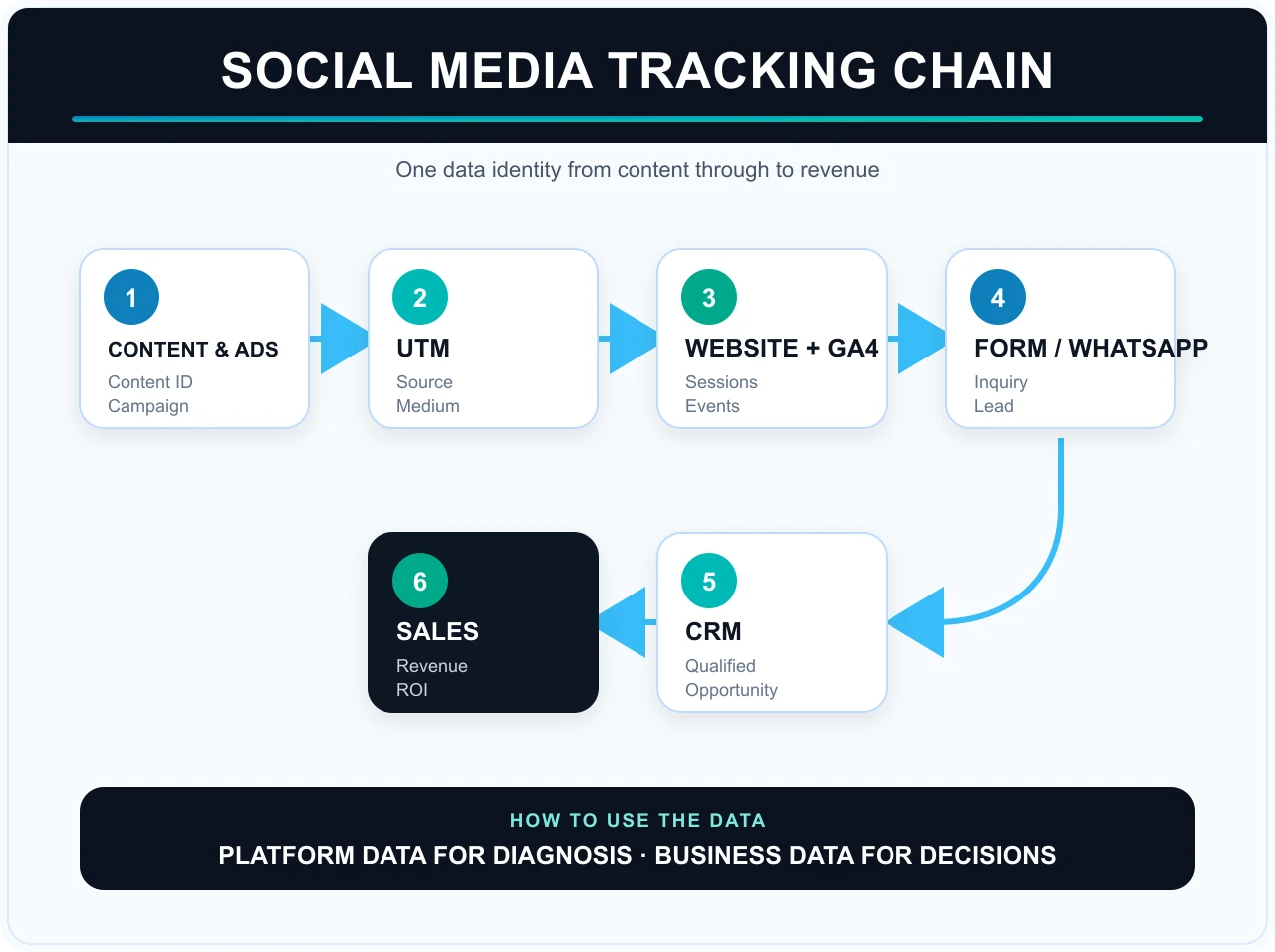
Then connect:
- Platform data
- GA4
- Forms or click-to-WhatsApp
- CRM
- Lead status and revenue
Without that connection, social media may appear to generate engagement while its business contribution remains unclear.
LINC practitioner note: maintain one data trail
In campaign measurement work, LINC uses a consistent identity from the content calendar through to the report. Campaign name, content ID, UTM parameters, and lead source should be traceable.
The practical checks are:
- Use one UTM naming convention.
- Record events that represent genuine intent.
- Pass source and campaign into forms, WhatsApp flows, or CRM where possible.
- Separate incoming leads, qualified leads, opportunities, and sales.
- Use platform data to diagnose creative; use business data to decide budget.
How to calculate social media ROI
ROI should include total cost:
- Internal team
- Agency or freelancer
- Photo, video, and design production
- Tools
- Media spend
- Influencers or creators
- Landing pages and tracking
ROI = (profit attributed to social media − total social media cost) ÷ total cost × 100%
Attribution is rarely perfect. A customer may see a video, search for the brand on Google, read an article, and later contact the business through WhatsApp. Combine first-touch, last-touch, assisted conversions, CRM notes, and the simple question “How did you hear about us?” rather than forcing one metric to explain the whole journey.
Social media marketing examples
The examples below are illustrative frameworks, not claims about specific client results.
Example 1: local F&B business
Goal: increase weekday orders.
Approach: Reels show preparation and signature products; Stories feature polls and location; customer content builds proof; local-radius ads expand distribution; the CTA opens WhatsApp with a pre-filled message.
Measurement: reach in the service area, click-to-WhatsApp, conversations, orders, and cost per order.
Example 2: B2B ERP company
Goal: generate qualified demonstrations.
Approach: LinkedIn content explains the cost of fragmented reporting; carousels diagnose process bottlenecks; case studies address implementation risk; webinar clips are retargeted; the CTA leads to a process assessment.
Measurement: saves, visits from target companies, registrations, qualified leads, opportunities, and pipeline.
Example 3: professional services
Goal: build authority and consultations.
Approach: short expert videos answer common questions; carousels compare options; long-form articles provide depth; retargeting reaches visitors who read high-intent pages; the CTA offers a specific consultation.
Measurement: qualified views, article sessions, consultations, close rate, and revenue.
How much does social media marketing cost?
There is no universal figure. Separate three cost layers:
- Foundation: research, strategy, account setup, tracking, and reporting structure.
- Production and operations: copy, design, video, community management, and approval.
- Distribution: media spend, creators, partnerships, and amplification.
The budget changes with platform count, format complexity, frequency, response requirements, media spend, and tracking needs. Start with enough budget to learn, but define in advance what would justify scaling or stopping.
Social media marketing tools
Tool categories include:
- Planning and project management
- Design and video production
- Scheduling and publishing
- Social listening and inbox management
- Platform analytics
- GA4 and dashboarding
- CRM and lead management
- Ad platforms and creative research
A spreadsheet can be enough for a small team. Add software when a clear bottleneck appears—approval, asset versioning, scheduling, response, attribution, or reporting.
Advantages, limitations, and risks
Advantages
- Direct access to audiences and feedback
- Flexible organic and paid distribution
- Fast message and creative testing
- Support across awareness, conversion, and retention
- Rich market and customer signals
Limitations and risks
- Dependence on changing algorithms and platform policy
- Public complaints and reputation risk
- Constant production and response demands
- Incomplete attribution
- Wasted advertising budget
- Brand-safety, privacy, and permission concerns
Businesses should own the customer relationship where possible through websites, email, WhatsApp, and CRM.
Common mistakes to avoid
- Posting without a business objective
- Trying every platform
- Talking only about the company
- Publishing only promotional content
- Following trends without relevance
- Ignoring comments and DMs
- Skipping UTM and conversion tracking
- Judging content too quickly
- Disconnecting marketing and sales
- Treating organic activity as free
- Relying entirely on a platform-controlled audience
Social media marketing with LINC
LINC treats social media as one part of a growth system. Content and advertising create attention; the website explains the offer; WhatsApp and forms capture conversations; CRM supports follow-up; analytics show what produces leads and revenue.
That approach is useful for businesses that do not simply need “more posts,” but need marketing that can be explained and improved.
Explore LINC’s digital marketing services or schedule a consultation to map the right funnel for your business.
Frequently asked questions
What is social media marketing?
What does social media marketing do?
What are the main components of social media marketing?
How should a business start social media marketing?
What are the benefits for a business?
Which platform is best for business?
Is organic or paid social better?
How much does social media marketing cost?
How do you measure success?
How long does it take to produce results?
Sources and further reading
Sources are selected according to their proximity to the claim: digital-use research for Indonesia and official platform documentation for metrics and tracking.
- Digital 2026: Indonesia — DataReportal
- Reach and impressions — Meta Help Center
- Campaign URLs and UTM parameters — Google Analytics Help
- LinkedIn Campaign Manager performance metrics
- TikTok Creative Center
The bottom line
Social media marketing is a system for moving people from attention to business action. It needs connected goals, audiences, messages, platforms, content, interaction, distribution, tracking, and follow-up.
Start with one objective and one audience. Create content around real problems, choose platforms based on customer behavior, direct attention toward a website or conversation, and measure through to qualified leads and revenue.