
Almost every buying journey now starts the same way: someone types a question into Google. They are looking for a product, a supplier, or an answer — and they tend to trust the results that come back. Search engine optimization (SEO) is how your business becomes one of those results, without paying for every click. Done well, it is the most durable and cost-effective source of customers most companies have.
Yet SEO is also widely misunderstood — treated as a one-time checkbox, or a bag of tricks to fool Google. It is neither. SEO is a discipline built on a few solid pillars, and once those pillars are in place, the traffic compounds. This guide explains why SEO matters, how search engines actually work, and the core pillars every effective SEO strategy is built on.
What is SEO, really?
SEO (search engine optimization) is the practice of improving your website so it ranks higher in the organic — unpaid — results of search engines like Google. The goal is simple: when your customers search for what you offer, your business is one of the answers they find and trust. Everything else is detail.
Why SEO matters for your business
It is tempting to treat SEO as a “nice to have.” For most businesses it is closer to essential. A few reasons stand out:
- It captures demand that already exists. Someone searching “ERP implementation Indonesia” or “SMS OTP provider” is already looking to buy. SEO puts you in front of high-intent buyers at the exact moment they are deciding.
- The traffic compounds. A page that ranks keeps bringing visitors month after month with no cost per click. Ads stop the moment the budget stops; a ranking page keeps working.
- Lower cost per lead over time. SEO takes investment up front, but as rankings hold, the cost of each lead keeps falling — often well below paid channels.
- Trust and credibility. Ranking organically signals that you are a legitimate, established option. Many people trust organic results more than ads, and the top few results capture the large majority of clicks — so position matters.
- It works around the clock. A ranking page sells, qualifies, and answers questions 24/7, in every time zone, without extra spend.
- It helps customers find you locally. For Indonesian businesses, “near me” and city-specific searches on mobile are where a huge share of buying decisions begin.
How search engines actually work
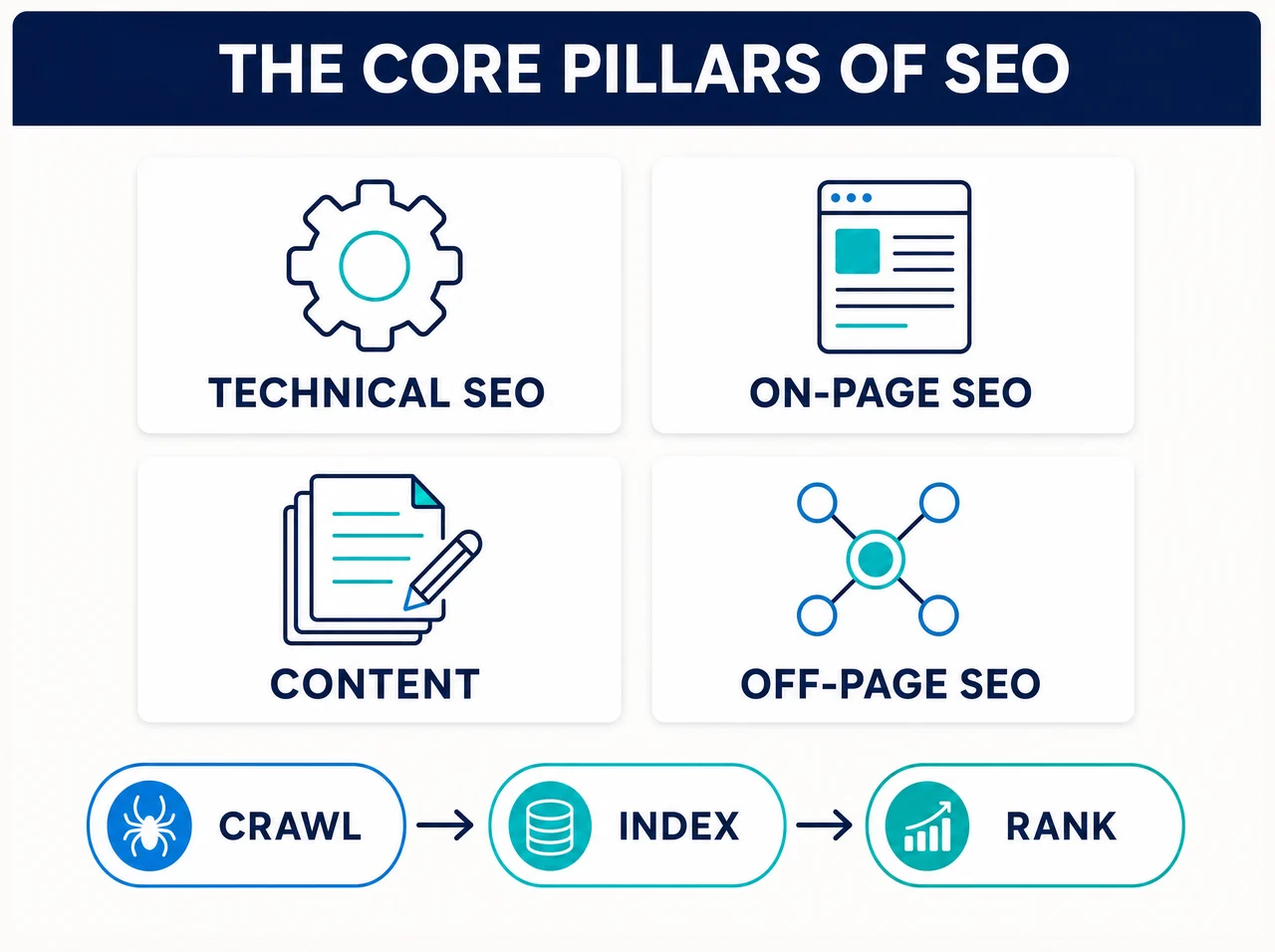
Before the pillars make sense, it helps to know what Google is doing behind the scenes. There are three steps:
- Crawling — Googlebot follows links across the web to discover your pages.
- Indexing — Google stores each page and tries to understand what it is about.
- Ranking — when someone searches, Google orders the indexed pages by how well they answer that specific query.
SEO is simply the work of making all three easy: easy to crawl, easy to understand, and clearly the best answer to the question.
The core pillars of SEO
Almost everything in SEO falls under four pillars. Get all four right and they reinforce one another.
1. Technical SEO — can Google reach and read your site?
Technical SEO makes your website fast, crawlable, and indexable. That means mobile-friendly pages, fast loading (Core Web Vitals), a clean site structure, working internal links, an XML sitemap, HTTPS, and no accidental noindex tags or robots.txt blocks on important pages. If Google cannot crawl or render your pages, nothing else you do will matter.
2. On-page SEO — does each page match what people search?
On-page SEO aligns each page with a clear search intent. That includes a focused title tag and H1, descriptive headings, content that genuinely answers the query, a clean and readable URL, internal links to related pages, and descriptive image alt text. The key idea is simple: one primary topic per page, matched to the way people actually search.
3. Content and topical authority — do you deserve to rank?
Rankings ultimately go to the page that best satisfies the searcher. That rewards helpful, original content with real depth — covering a topic and its follow-up questions rather than publishing thin, single-keyword pages. This is also where E-E-A-T comes in: Experience, Expertise, Authoritativeness, and Trustworthiness. Google increasingly favors content from real, credible authors and businesses — named authors with relevant experience, accurate and well-sourced information, and a transparent, contactable company behind the site.
4. Off-page SEO — what does the rest of the web say about you?
Off-page SEO is the authority you earn beyond your own website. The biggest factor is backlinks — links from other reputable sites act like votes of confidence. It also includes brand mentions, consistent business listings, reviews, and a presence in the directories and communities your industry trusts. Quality beats quantity: a handful of links from trusted, relevant sites outweigh hundreds of low-quality ones.
Local SEO: the extra layer for location-based businesses
If you serve customers in a specific city or region, local SEO sits on top of these pillars. Claim and optimize your Google Business Profile, keep your name, address, and phone number consistent everywhere, gather genuine reviews, and build location-specific pages. For many Indonesian service businesses, this is where the fastest wins are.
SEO vs. paying for ads
A fair question: why invest in SEO when you can pay for the top spot with ads? Because they do different jobs. Paid ads (PPC) buy instant traffic but stop the moment you stop paying. SEO is slower to build but compounds and keeps working long after. For most businesses the smartest move is not either/or — it is the right mix of both. We break that down in our guide on SEO vs. PPC vs. social media.

And what about AI search?
Search itself is changing. More buyers now ask ChatGPT, Gemini, and Google’s AI Overviews instead of scrolling a list of links. The good news: the same SEO fundamentals — clear structure, helpful content, authority, and clean technical health — are exactly what AI engines use to decide who they cite. SEO is the foundation AI search is built on. We cover it in detail in how to get your business cited by AI search.
How to measure SEO
SEO is measurable — you do not have to guess. Track:
- Google Search Console — impressions, clicks, average position, and the queries you appear for.
- Organic traffic and conversions in Google Analytics 4 — not just visits, but the leads and sales that come from organic search.
- Keyword rankings for the terms that actually matter to your business.
- Authority signals such as referring domains, tracked over time.
Tie everything back to business outcomes — leads and revenue — rather than vanity metrics.
How long does SEO take?
The honest answer: usually six to twelve months to see meaningful results, and longer for competitive terms or brand-new websites. Technical fixes can help within weeks, but content and authority build gradually. SEO is an investment that compounds — the cost per lead keeps dropping as rankings hold. The businesses that start now are the ones that own that visibility later.
Common SEO mistakes
- Treating SEO as a one-time project instead of an ongoing discipline.
- Chasing keywords instead of search intent and genuine helpfulness.
- Ignoring technical health — a slow or un-crawlable site caps everything else.
- Thin or duplicate content with no real value to the reader.
- Buying low-quality backlinks — a risk, not a shortcut.
- No measurement — flying blind without Search Console and GA4.
Where LINC stands
SEO rewards businesses that get the fundamentals right and keep at them. LINC’s digital marketing services cover technical SEO, on-page and content, authority building, and local SEO — run by one accountable team and measured against real business outcomes. If you want to know where your site stands today, and a clear plan to rank higher, schedule a consultation.
Frequently asked questions
What is SEO in simple terms?
Why is SEO important for a small business?
What are the core pillars of SEO?
How long does SEO take to show results?
Is SEO better than paid ads?
Does SEO still matter now that people use ChatGPT and AI Overviews?
Can I do SEO myself?
The bottom line
SEO matters because it earns you the one thing ads can only rent: durable visibility in front of people who are already looking for you. It is not a trick. It is four pillars done consistently — a technically sound site, pages that match real search intent, genuinely helpful content from credible authors, and authority earned across the web. Get those right, keep them fresh, and the traffic compounds for years.