More and more buyers no longer start their search from a list of blue links. They ask ChatGPT, Google AI Overviews, Gemini, or Perplexity, and then read an AI-written answer. Google AI Overviews already appear in roughly half of all search results, and ChatGPT has around 800 million weekly users. If your business does not make it into those answers, you are invisible to a fast-growing market segment — even if your traditional rankings are already strong.
The good news: getting into AI answers is something you can learn. Because this field is still new, smaller businesses can compete far more easily than in classic SEO. Many competitors have not started yet, so the opportunity is still wide open. This guide explains how AI search chooses its sources and gives you a practical plan to make your business one of them.
What is AI search optimization?
AI search optimization is the practice of structuring your content and online presence so that AI systems cite your business when they answer questions. It usually breaks down into AEO (Answer Engine Optimization — being chosen for direct AI answers such as Google AI Overviews) and GEO (Generative Engine Optimization — being cited by large language models such as ChatGPT and Gemini). Both build on top of traditional SEO rather than replacing it.
How AI search differs from traditional SEO
Traditional SEO gets you ranked. AI search gets you cited. That difference changes the game.
In classic search, you fight for a spot on the first page and chase clicks. In AI search, the assistant reads many sources, synthesizes a single answer, and then names a few sources as citations. You can be cited even if you rank on page two or three, because AI systems choose sources based on how clearly the content answers the question, how trustworthy it is, and how easy the information is to extract — not just ranking position.
Clicks also change shape. When AI Overviews appear, clicks to the top organic result can drop by more than half. But brands cited inside the AI answer capture a disproportionate share of the remaining clicks. The goal is no longer simply to “rank,” but to “be the source the AI cites.”
SEO vs. AEO vs. GEO
The three work together. SEO is the foundation; AEO and GEO add structure and authority on top of it.
| Discipline | Goal | Optimized for | Core tactics |
|---|---|---|---|
| SEO | Rank in the results list | Google / Bing | Keywords, links, technical health, content quality |
| AEO | Win the direct answer | AI Overviews, featured snippets | Question-style headings, concise answers, FAQ schema |
| GEO | Get cited by LLMs | ChatGPT, Gemini, Perplexity | Statistics, expert quotes, citations, facts consistent everywhere |
You do not have to choose one. The same page should be able to rank, answer, and be worth citing.
How the major AI engines choose their sources
Every AI engine chooses sources a little differently, so it is important to understand who you are optimizing for.
| Engine | How it chooses sources | Top priority |
|---|---|---|
| Google AI Overviews / Gemini | Built on top of Google’s core ranking; pulls from top pages + the Knowledge Graph | Strong traditional SEO, E-E-A-T, clean indexing |
| ChatGPT with search | Searches the web and cites a broader range of sources, not only the top-ranked pages | Easily extractable structure, third-party mentions |
| Perplexity | Always lists citations; tends to favor authoritative, recent, well-organized content | Fresh content, clear answers, sourced statistics |
| Microsoft Copilot | Bing index + authoritative sources | Visibility on Bing, structured pages |
Two takeaways: Google’s AI features still reward good SEO, while ChatGPT and Perplexity reward clear structure and a third-party presence more heavily.
The content types that get cited most often
Some formats are pulled into AI answers far more often. If you are deciding what to publish next, prioritize these:
- Comparison content (“X vs Y,” “best tools for…”) — clear, structured, high-intent, and the most frequently cited format.
- Original research and data — unique numbers that can be quoted and attributed to you.
- Definitive guides — comprehensive coverage of a topic and its follow-up questions.
- How-to guides — step-by-step structure fits “how do I…” queries.
- FAQ pages — direct question-and-answer pairs are the easiest format to extract.
Thin marketing pages (“we’re the best”), gated PDFs, and undated articles are rarely cited. Start with a comparison or a data-driven guide.
How to get your business cited by AI search
Here are the highest-impact steps for raising your AI visibility, roughly in priority order.
1. Open every page with a direct answer
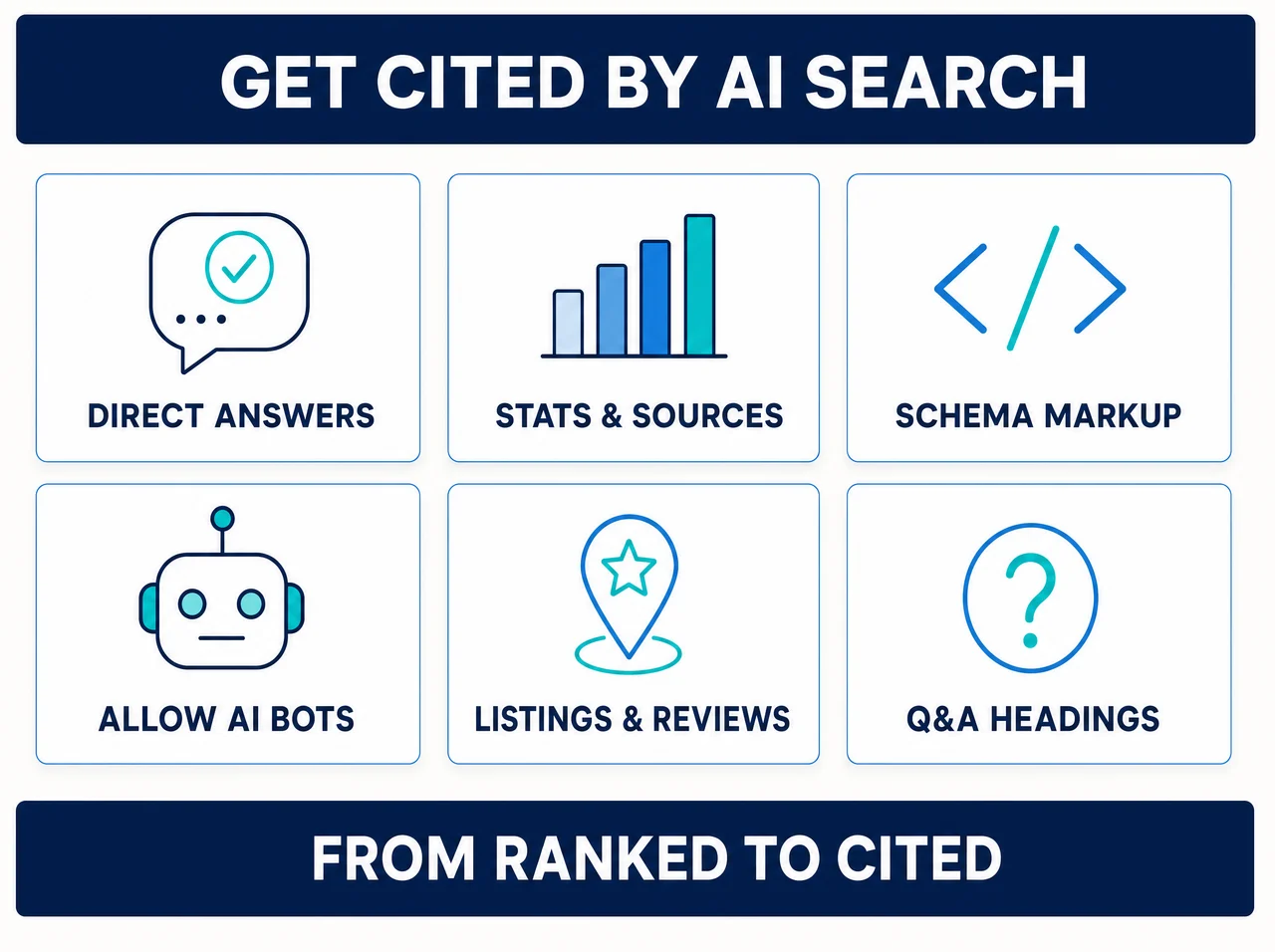
AI systems extract passages rather than reading the whole page as a single unit. Start every important page or section with a self-contained answer of about 40-60 words that still makes sense if quoted on its own. Put the plain answer first, then the detail. If the answer is buried three paragraphs down, the AI may not find it.
2. Add original statistics and cite your sources
This is one of the biggest levers. A 2024 Princeton study on Generative Engine Optimization found that citing authoritative sources and adding statistics could each raise a page’s visibility in AI answers by about 40%, while keyword stuffing actually lowered it by about 10%. Include specific numbers, attribute them, and date them. Your own original data is even more citable than quoting others. If you do not yet have major research, small internal statistics — such as average project timelines, support response times, or delivery rates — still give the AI something concrete to cite.
3. Use schema markup
Structured data tells AI systems explicitly what your content is about. At a minimum, add Organization schema for your business identity, Article / BlogPosting for articles, and FAQPage for question-and-answer sections. It is not always required for Google’s AI features, but it helps other engines understand and trust your pages.
4. Build a third-party presence
AI engines cite the places you appear, not just your own website. They also rely heavily on community and reference sources. Analyses through 2026 show that platforms like Reddit, Quora, and Wikipedia take a large share of AI citations. Practical steps: tidy up your listings and review profiles, answer questions authentically in relevant communities, get into industry roundups, and make sure your business name, address, and phone number are consistent everywhere. For B2B service companies, the most valuable places are usually industry directories, Google Business Profile, LinkedIn, and genuine answers in the communities where buyers ask questions.
5. Let AI crawlers in
If your robots.txt blocks AI bots, those engines cannot cite you. Make sure the following bots are allowed: GPTBot and ChatGPT-User (OpenAI), PerplexityBot (Perplexity), ClaudeBot (Anthropic), Google-Extended (Gemini and AI Overviews), and Bingbot (Copilot). Blocking crawlers can protect your content from being used for training, but it also removes you from AI answers. For a business that wants to be found, that is usually a bad trade-off.
6. Write headings as the questions people actually ask
Use H2 and H3 headings phrased like real questions: “How much does X cost?”, “Is X better than Y?” Then answer them directly underneath. This structure matches how AI systems map passages to queries.
7. Keep facts consistent everywhere
AI systems trust facts that appear repeated accurately across your website, your listings, and third-party sources. Inconsistent details — like a different address or contradictory claims — make you look riskier to cite. Say the same true thing everywhere.
8. Cover topics thoroughly and keep them fresh
Google’s AI features “fan out”: they generate several related sub-questions and answer them from various sources. So depth wins. A page or cluster of pages that covers a topic and its follow-up questions completely will make it into answers more often than a thin, single-keyword page. Show a “last updated” date and refresh competitive content regularly.
9. Make key facts machine-readable
AI assistants — and a new wave of AI agents that research and shortlist vendors before a human gets involved — increasingly read websites programmatically. Help them: add an llms.txt file at the root of your website with a plain-text summary of what you do, who you serve, and links to your main pages. Make sure important information such as your services, how to start working with you, and contact details live in indexable HTML rather than being locked behind JavaScript or a “contact sales” wall. If an agent cannot read your website, it will recommend a competitor it can read.
A simple starter plan
You do not have to do everything at once. A realistic first pass:
- Check
robots.txtand open access for the AI crawlers listed above. - Add Organization + FAQ + Article schema to your main pages.
- Rewrite the top of your most important pages so they answer directly in 40-60 words.
- Add FAQs to your top three pages using real customer questions.
- Add two or three sourced statistics to your cornerstone content.
- Claim and align your business listings and review profiles.
This is a weekend’s work that can put you ahead of the many competitors who have not started.
How to check whether it is working
There is no AI-specific Search Console report yet, so measure it directly. Once a month, take your 10-20 most important questions and ask them in ChatGPT, Perplexity, and Google. Note whether your business is mentioned, who else is mentioned, and which pages are cited. Watch analytics for referral traffic from chatgpt.com, perplexity.ai, and gemini.google.com. Dedicated tools such as Otterly, Peec AI, and ZipTie can track this across platforms at greater scale.
Common mistakes to avoid
- Blocking AI bots in
robots.txt— you become invisible to those engines. - Creating separate “AI content” — the same page should serve both humans and AI; thin pages built only for AI risk being treated as spam.
- No statistics or sources — “we’re the best” does not get cited; “customers see onboarding 3x faster” is far stronger.
- Undated content — recency is a trust signal; show when the content was last updated.
- Ignoring your third-party presence — you may get more citations from a community thread or a review profile than from your own blog.
Where LINC stands
Earning AI citations is now part of SEO, not a separate project. Many businesses have not started yet, and that is exactly where the opportunity lies. LINC’s digital marketing services cover SEO and technical SEO, structured data, content, and the AI search structure described above — run by one accountable team and measured against real results. If you want to know whether AI assistants currently mention your business — and to fix it if they do not — schedule a consultation.
Frequently asked questions
Is AI search optimization different from SEO?
Do I need high domain authority to be cited by AI?
How long until I appear in AI answers?
Will AI optimization hurt my normal Google rankings?
How do I know whether my business already appears in AI answers?
Which matters more, ChatGPT or Google AI Overviews?
Do I need an llms.txt file?
The bottom line
AI search rewards businesses that are easy to cite: a direct answer at the top, real numbers with sources, clean structure, schema, open crawler access, and a presence beyond your own website. None of this requires a big budget. What it requires is doing the fundamentals before your competitors do. The companies that show up in AI answers now will hold that visibility as more and more buyers stop scrolling and start asking.